

Sawdust — How a Radial Arm Saw Shaped a Lifetime of Woodworking
Quick Answer — What This Story Really Teaches
Before you learn joinery or grain direction, you learn sawdust — the smell, the texture, the atmosphere of a working shop. And for me, that first connection came from a radial arm saw humming in a dim room, teaching lessons long before I knew I was learning them.
Smell becomes memory — the first sensory lesson in craft
Sawdust teaches material differences long before you know species names
Early shop moments shape identity — the beginning of a woodworker’s story
A radial arm saw creates the first real connection between tool, sound, and craft
How a Pile of Sawdust Became the First Lesson in Craft
Sometimes the earliest lessons in a woodworker’s life aren’t taught — they’re inhaled. Long before tools made sense, long before grain direction mattered, there was the smell of sawdust drifting through a dim shop. This is the story of the first pile that shaped me.
BY THE END OF THIS STORY
You’ll understand why sawdust is more than a by‑product — how smell becomes memory, how early shop moments shape a lifetime of craft, and how a simple pile under a radial arm saw became the beginning of everything I’ve built since.
Estimated read time: 7 minutes
Fast Summary
This story reflects on how a simple pile of sawdust under a radial arm saw became the first lesson in craft, memory, and identity. It traces how smell, sound, and early shop moments shape a woodworker’s life, how a single machine can follow you through decades, and how passing those memories to your son becomes part of the lineage of the craft.
The First Shop, the First Smell, the First Lesson
When I was young — real young — when those first memories were just starting to stick, the kind that flicker fifty years later like a rerun on worn and brittle film, we were living in our first home. With young eyes and a big imagination, Dad’s workshop was a wonder to behold. Tools hung on the wall neat and tidy, lights dim, sawdust clinging to the bare bulbs. But what sticks with me most was the sawdust piled under the radial arm saw — its texture, its colour, its unmistakable smell.
Even then I knew different wood meant different smells. Old dust smelled different than new dust. Plywood, spruce, cedar, oak — I didn’t know the names yet, but the smell was my earliest woodworking lesson. And most of that smell came from the pile under Dad’s radial arm saw.
The Radial Arm Saw That Started It All
To me it was just a big, noisy machine that made the sawdust. But that saw followed me my whole life. Dad still has it — still hums. We grew, we moved, and that saw became the first real power tool I ever used — a tool that actually cut wood. Drills and sanders didn’t count. This machine made real sawdust, the kind that clung to walls, clothing, and furniture — clouds big enough to get my mother in a tizzy if I didn’t clean up after myself.
That saw opened worlds for me — cutting with precision, cutting fast. Once Dad gave me the nod — that little look that said you’re doing good, my boy — I started using it when he wasn’t around. I was fourteen years old, running that radial arm saw alone. That’s how kids in the 80s learned. I felt safe on that saw. It was predictable, logical, simple. Granted, I was crosscutting narrow strips of plywood — the safest cut it makes — but still. It was my first taste of cutting wood with speed. No more hand saws. Like moving from a tricycle to a bicycle. No looking back.
Growing Up in Sawdust
I kept cutting and building, and the sawdust kept piling up. Small things — stools, shelves, clocks, whatever I could dream up if I could find wood. The saw would hum. I got better at it. Got into junior high shop class. Built bigger things. Worked with the neighbour in his pro shop for three bucks an hour. Then a summer job at Marvin Windows in Winnipeg sweeping floors. And then I got a car and didn’t look at woodworking for a long while.
Life goes on. I met my future wife, had a kid, bought a house — and all I had was a hand saw. That wouldn’t do.
The First Radial Arm Saw of My Own
A few years later we had a little extra money, and an oldster down the road put up a bulletin at the local Co op selling his entire shop. My wife brought the number home. The fellow lived just up the street. I went to look — he was in the basement of the old folks’ home with the personal tools he’d brought from his house. He didn’t want to lose his shop, but arthritis had taken his hands and it was time to let them go.
I bought almost everything with a smile on my face, including my first radial arm saw. My saw — not Dad’s. This was the grand prize for me. I inspected it, set it up, pushed the button… it started spinning, the lights dimmed, flickered, and then it blew the fuse. Good times. Many fuses were blown that summer.
As the years passed, the old shop came down and a new one went up — power to spare. It’s rare today to trip a breaker. Eventually the day came to let that old saw go. I found a newer 12 inch model. More power, more noise, more sawdust. Though now it has dust collection custom fit to the saw. And it’s still my favourite in the shop. Not because it’s the best tool — not even close — but because it reminds me where I came from and where I’m going.
Passing the Memory Forward
I’ve taught my own son “Leo” on this saw, and it’s second nature for him to use it. The saw is his favourite for reasons similar to mine, like he has an old memory flickering in the background of his thoughts. That hits me in a deep way. It gets me thinking back to that little boy playing in the sawdust pile, creating dirty, dusty laundry for my mom to wash. But I guess that sawdust got in my soul, because I’m still getting dusty to this day with my own son. The smell of my dad’s old shop still lives in my mind, and I hope it always will.
And maybe one day, if I’m lucky enough to have a grandchild, I’ll be right back in the sawdust pile with them — building memories, smelling the sawdust.
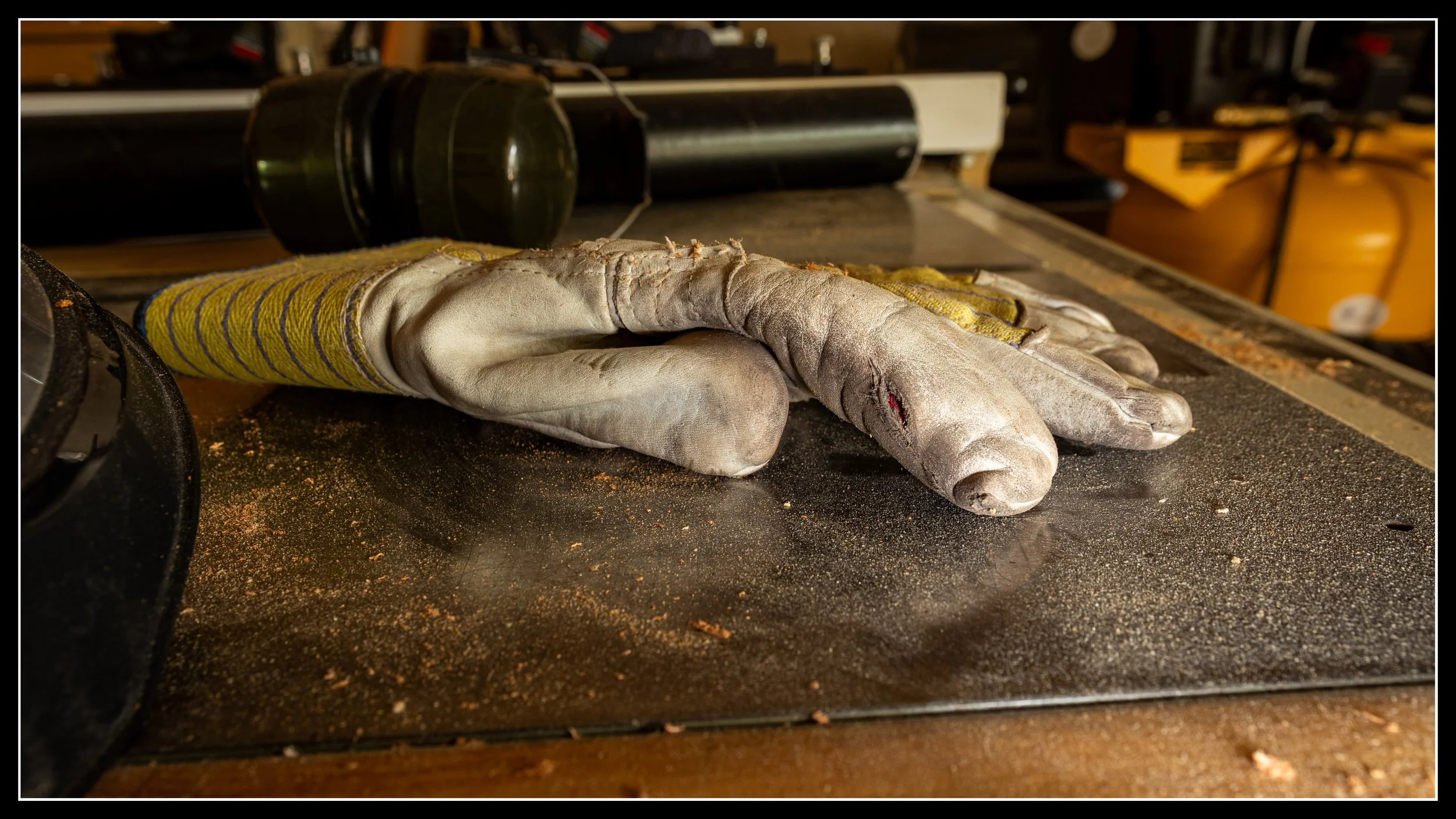
Worn Shop Glove on the Bench
A single worn glove resting on a dusty bench says more about shop life than a perfect setup ever could. The creases, the scuffs, and the settled dust all hint at years of work — quiet mornings, long afternoons, and the kind of repetition that builds both skill and memory. It’s a small moment, but it carries the whole atmosphere of a working shop.
This story is part of a small collection of reflections about the tools, lessons, and quiet moments that shape a woodworker’s life. These aren’t tutorials — they’re the memories and experiences that teach us how to see the craft differently, one quiet moment at a time.
SHARE
The Quiet Stories — Connected Through Behind the Grain
For the quiet side of woodworking — The Quiet Stories that sit behind the grain, where the background work, the memories, and the cancer chapters live — head to Behind the Grain.
If you’d like to hear from me only when something big is happening — a launch, a milestone, or a major project — you can join the mailing list below.
Written by David Flather, Red Seal cabinetmaker and founder of Knotty Dave’s Fine Woodworking — a Manitoba shop rooted in heritage restoration, storytelling, and real craft.
All photos shot by David Flather — in the shop, on the road, and in the places where craft and story meet.
Related stories:
How to Arrive at Perfect: A Quiet Story About Imperfection in Woodworking
The Power of Lazy: A Quiet Story About Working Smarter in the Shop
Grandpa’s Toolbox: A Quiet Story of Heritage Tools and Generational Woodworking
The Workshop Library
If you enjoyed this story, there’s lots more like it inside The Workshop Library — and it’s free to explore.
Wood Archive — species, grain, working properties, and real‑world craft notes
Behind the Grain — the deeper stories inside wood, craft, and heritage
The Working Side of the Craft — tools, shop life, workflow, and the realities of making
Digital to Sawdust — Design Studio — geometry, proportion, visual flow, and design thinking
The Stories of the Shop — the personal side of craft, the shop’s history, and the quiet moments that shape the work
House & Hearth — heritage home restoration, the hearth room, winter culture, and the lived‑in side of craft
I’m just one man with a shop, building this archive one story at a time. If you’d like to follow the journey as it unfolds, explore The Workshop Library — new stories every week.
