

The Jointer: Eliminating the Twist
Quick Answer — What does a jointer actually do?
A jointer removes cup, bow, crook, and twist — doing what a planer can’t. It creates the first true flat face and a straight, square edge, giving every other machine in the shop a reference surface that makes woodworking accurate instead of frustrating.
A jointer removes twist — it flattens the first face and straightens the first edge.
A planer makes faces parallel — it copies whatever shape the board already has.
A jointer fixes the shape — cup, bow, crook, and twist are eliminated.
A planer fixes the thickness — but it cannot correct warp.
A jointer creates the reference surface — every other machine depends on this first true face.
A planer depends on the jointer — without a flat face, the planer simply copies defects.
Together they turn rough lumber into real material — flat + straight, then parallel + thickness.
How a Jointer Removes Cup, Bow, Crook, and Twist — The Machine That Makes Wood Honest
The jointer is the tool that separates real woodworkers from wannabes. It’s not a machine you use every day, but when you need straight, honest wood, nothing else can do its job. The jointer eliminates twist, cup, bow, and crook, and it quietly decides whether your projects end up square and proud—or crooked enough to make you think about selling your tools and taking up golf.
BY THE END OF THIS STORY
You’ll understand how a jointer actually removes cup, bow, crook, and twist, why straight knives and carbide cutterheads behave differently, how jointer size and bed length affect real workflow, why pre‑dressed lumber still moves after milling, and why the jointer is the machine that quietly decides whether your projects end up straight, square, and worth being proud of.
Estimated read time: 6 minutes
Fast Summary
A jointer removes cup, bow, crook, and twist — doing what a planer can’t. This Ramble explains how a jointer creates the first true face, why carbide cutterheads change cut quality, how bed length affects accuracy, and why pre‑dressed lumber still moves. It’s the straight truth about the machine that quietly decides whether your projects end up square, safe, and worth being proud of.
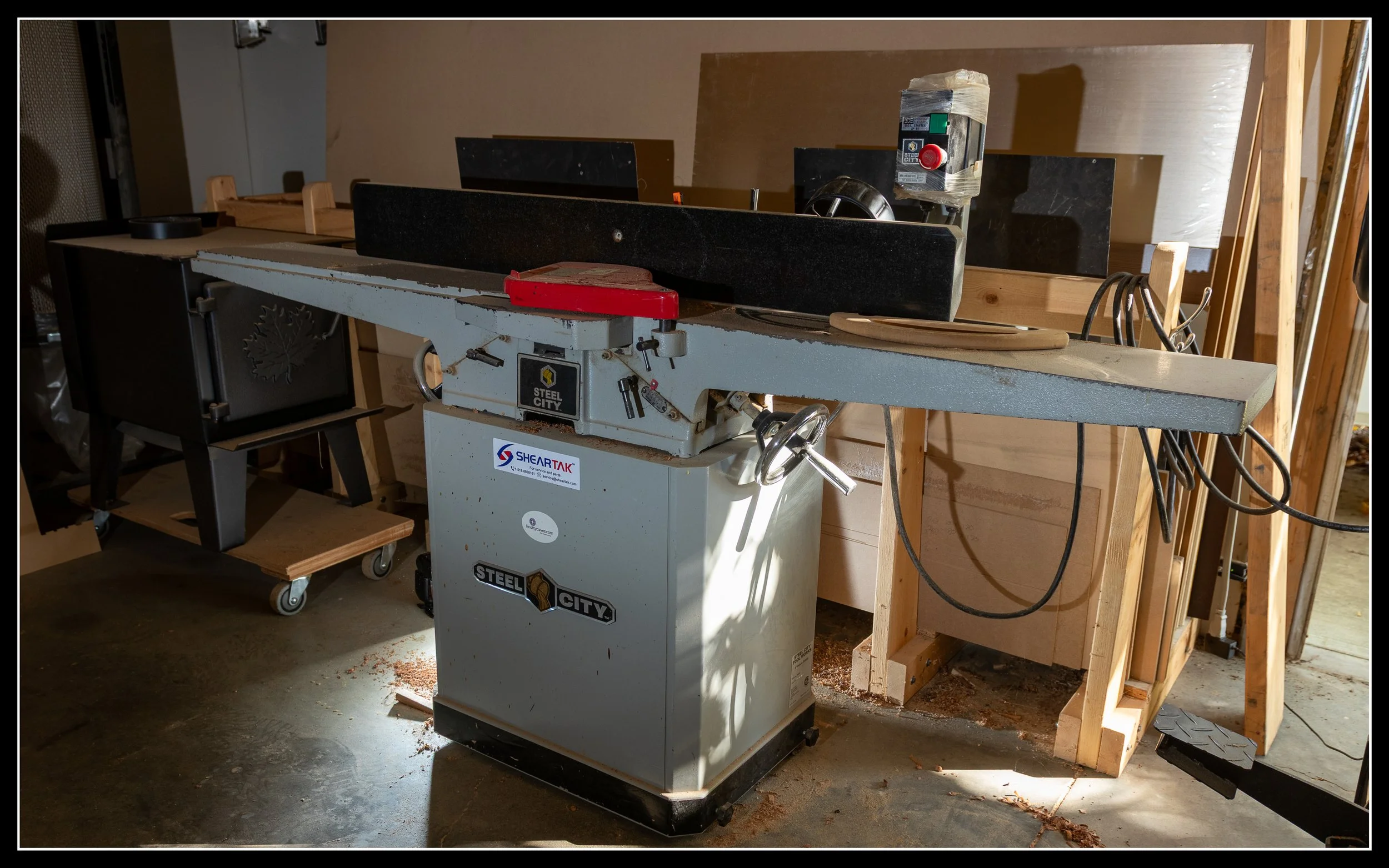
Steel City 8" Jointer — Reliable, Quiet Workhorse
This Steel City 8" long‑bed jointer has been in my shop for years, doing exactly what a jointer is supposed to do: flatten faces, straighten edges, and eliminate twist without complaint. It’s not the best jointer ever made and it’s not the worst — it’s the dependable middle ground that keeps a workflow honest. With the upgraded carbide cutterhead, it handles hardwoods cleanly and consistently, turning rough, unpredictable boards into straight, square material ready for the planer or table saw. A simple machine, but one that quietly earns its keep every time it’s switched on.
The First Time a Jointer Made Sense
I remember the first time I saw a jointer in use. A professional woodworker had hired me for part‑time help in his shop after school — somewhere between grade 7 and 9. He had a lot of big tools in that shop, or at least they felt big to me as a kid. My opinion might be different today if I could walk into that shop one more time.
I remember him edging and facing boards, almost exclusively cedar. This tool made horrible wood look good. Sometimes he would drop the infeed table as low as it could go, start the jointer, and place the edge of a board with one end on the infeed and the other on the outfeed. Then he’d feed the board to a pencil line drawn about 2½" from the edge and stop. Lift the board off the bed, spin it around, repeat on the other side. He’d do this to twenty boards, then lower the outfeed to match the infeed and carefully repeat the operation to clean out the tapered wood he missed on the first round.
He was making plinth box bases for cedar chests. I was a kid, and this really impressed me. He had all kinds of woodworking tricks, and this was just one. It was the first time I saw the value of a jointer in a shop.
Learning Jointers Through Childhood Shops
Around the same time, my dad inherited my grandfather’s 4" Delta jointer. I knew what the machine did and what I could safely accomplish with it, but it wasn’t like the jointer I was used to. The knives were short and worse — the bed was short. What could be done with it was limited. I figured that out quickly, but I had a jointer I could use, and that was enough.
In school shop class we had a nice 6" jointer. We had to be supervised to use it and weren’t allowed to adjust anything. All we used it for was edge‑jointing for glue‑ups and edging for plywood. Very basic training — you can’t expect much from junior high school.
Later, in Cabinetmaking college, they had an 8" Delta. The instructors didn’t like it — they said it was a poorly made unit from China. This was an era when these guys grew up with Canadian and American cast‑iron machines. I felt what they were saying, especially when the other jointer in the room was a huge long‑bed 16" Canadian‑made General. That machine was the most impressive jointer I’ve ever used. It was so big only a forklift could move it. The Delta was lightweight — one person could move it alone — but it did the job.
One of the first things we learned was changing knives. These were high‑speed steel. Using jigs, resetting the beds, eliminating snipe — all part of the process. Carbide cutterheads were just entering the market. The college had one planer with a carbide head — a sign of a changing future.
The Steel City Era — My First Real Jointer
After college, I finally had to decide what kind of jointer belonged in my own shop. Around 2008 I started looking for a used 8" jointer, but none I liked came up. So I bought a new Steel City 8" long‑bed jointer.
The Steel City worked great, but it came with a cutterhead that used disposable knives. That was fine — I could swap them anytime. A few years later, the original U.S. Steel City company shut down, and the knife supply dried up. The Canadian Steel City brand continued on, but the disposable knives for my cutterhead were no longer being made. My only option was upgrading to a carbide helical head.
Upgrading to Carbide — When Cut Quality Changes Everything
I would never have done this if I could still buy HSS knives. I was forced into the decision. But as soon as I started cutting with it, the cut quality was massively better — way less tear‑out, and the jointer didn’t fight the wood as much. The face cuts were so smooth the surface could be used as the finished face. Before, there were too many imperfections.
A carbide cutterhead was absolutely worth the upgrade.
This Steel City jointer is fine for my small shop. It’s light enough that I can move it, even take it outside for long boards. The cutterhead made this old machine so much better that I’ll continue working with it for years.
Why a Jointer Exists — The Machine That Stops the Fight
Woodworking gets stressful when the wood fights you. The jointer is the machine that stops the fight.
A lot of people wonder: Do I really need a jointer? Here’s the truth.
The jointer is the dividing line between real woodworkers and wannabes. It’s the machine that removes cup, twist, bow, and crook. It does this in combination with other tools like the table saw, crosscut saw, planer, and sometimes the bandsaw. The jointer makes the table saw and crosscut saw safer by straightening the wood. The jointer makes the planer able to do its job effectively. And all of this makes a project square and straight.
The end result is either something you’re proud of — or something that makes you want to sell your tools and try your luck at golfing. I’ve been there, working without a jointer. This machine is the shift when woodworking becomes real, when what was impossible before becomes elementary. And people around you who can’t work a screwdriver without supervision suddenly think you have talent.
How Wood Moves — And Why Pre‑Dressed Lumber Still Warps
Wood comes pre‑dressed at a premium price, often milled in summer, stored in a warehouse, shipped to a lumber store, and sold months later. The humidity changes at every step. My shop ranges from 35% in winter to 70% in summer. Yours will have its own fluctuations.
Wood absorbs and releases moisture constantly. Even if the board is pre‑dressed, it will continue to move. The longer it sits, the more it acclimates — and the more it can warp or cup. It’s just wood.
If you buy pre‑dressed lumber, use it quickly. Don’t store it.
If you have a jointer, you dress the wood right before the glue‑up, before it moves again. Rough lumber is cheaper too — depending on how much you build, the savings can offset the cost of the jointer.
And yes — a new tool is fun. I don’t need to explain that part.
But here’s the real truth:
Planer vs Jointer — The Truth Most Beginners Miss
A planer cannot do what a jointer does. A planer makes one face parallel to the other. It copies the opposite face. If that face is twisted, it copies the twist — but makes it buttery smooth.
A jointer removes the twist. A planer can’t.
Do you need a jointer? You already know the answer.
If you’re a serious woodworker — if you work with solid wood on every project — then yes, you should have one. If you’re not sure, buy a used one. If you don’t use it, you can sell it for what you paid. Low risk.
Jointers are a one‑trick pony. But that one trick is the moment woodworking stops being a fight — and becomes fun again.
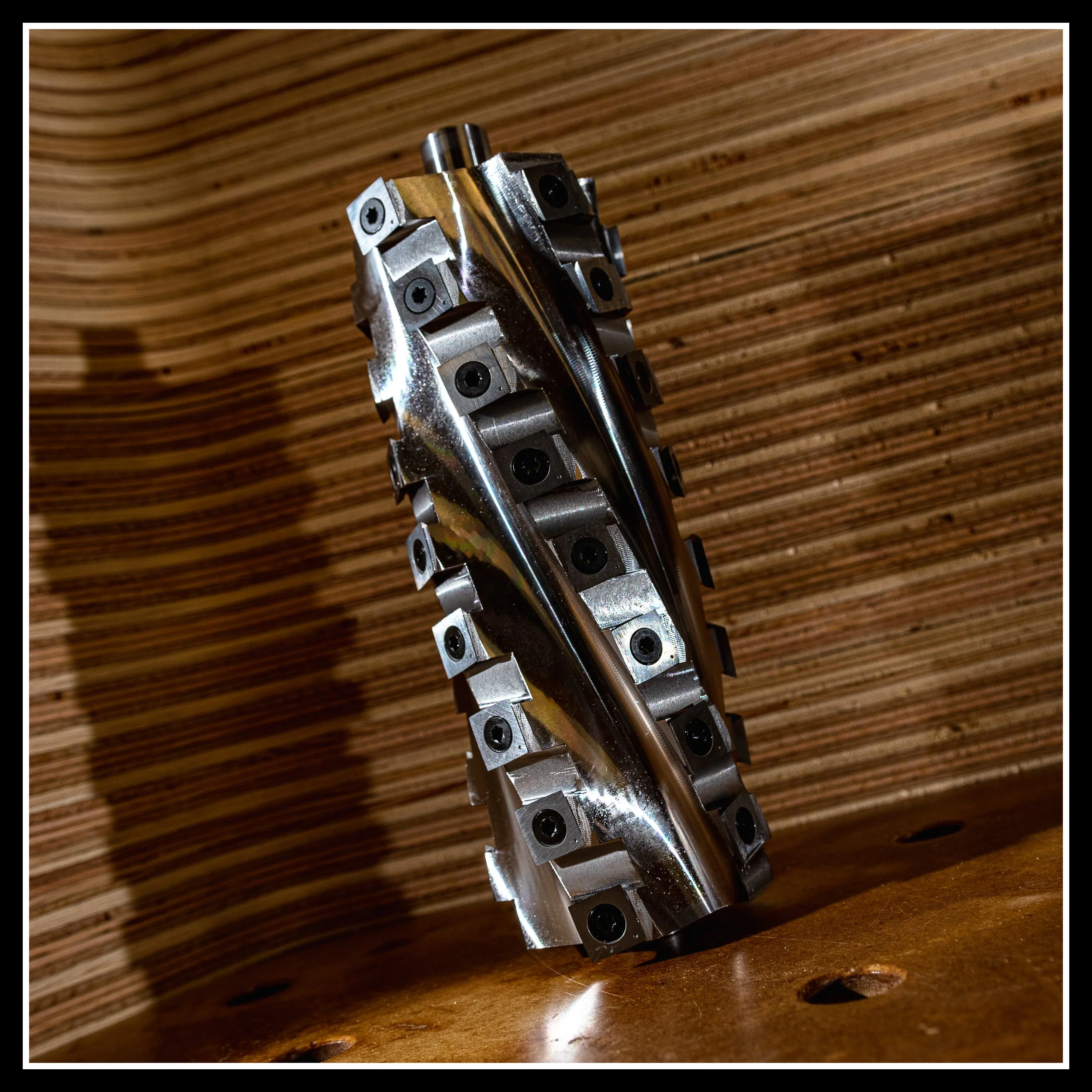
Carbide Helical Cutterhead — Precision, Quiet Power
This glam shot shows the new carbide helical cutterhead in all its precision. Every insert is perfectly machined, every spiral row aligned to shear the wood cleanly instead of tearing at it. It’s an impressive bit of kit — quieter, smoother, and engineered for modern milling. This is the upgrade that transforms a mid‑range jointer into a serious woodworking machine, the kind that handles hardwood without hesitation and leaves a finish that barely needs sanding.
Buying Advice — Choosing the Right Jointer for Your Shop
If you’re considering a new machine, bigger is better. Something with a 2 HP induction motor and 240 V is enough power for 8" knives. The key is getting what fits your shop and workflow. A jointer does one job — it cuts wood flat. Chances are if you buy one, it may be the last one you ever get, so buying a little bigger than your current workflow requires is future‑proofing.
Old jointers are often good buys, and there are carbide cutterheads available for almost every model. These aftermarket heads often seem better made than the ones installed in new machines. Look and compare the number of knives and the size of each cutter — I noticed a difference.
Years later I returned to the college shop. So many changes, so many new machines. But that giant 16" General jointer was still there — now upgraded to carbide. That machine was already impressive, and now it was even better.
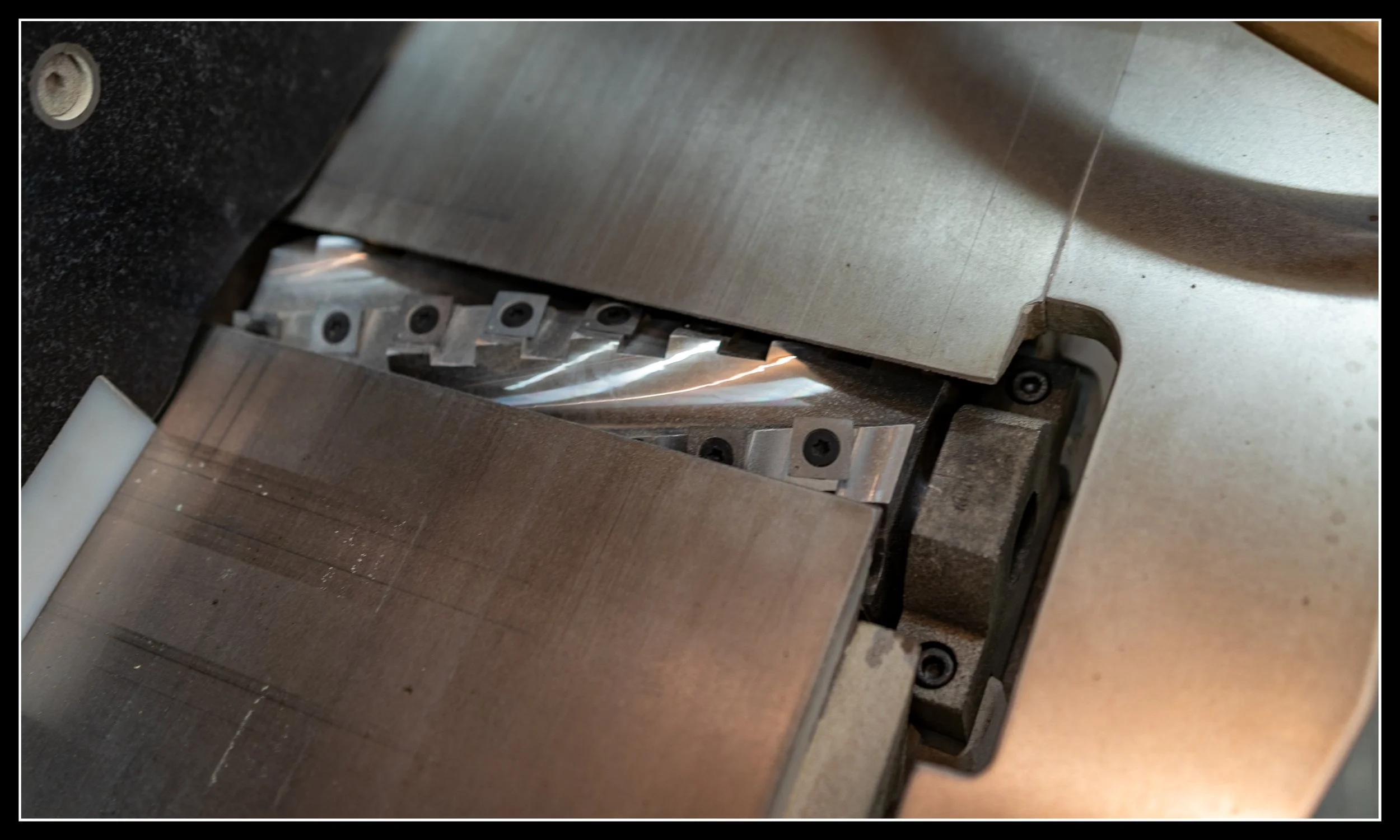
New Carbide Helical Cutterhead — Installed and Ready to Work
Here the new carbide helical cutterhead is finally installed in the Steel City 8" jointer. This is the moment the machine stepped into a different league. Every insert cuts cleanly, the cut quality jumps, and the jointer stops fighting the wood. It’s quieter, smoother, and far more forgiving on difficult grain. This photo captures the upgrade that turned a decent mid‑range jointer into a genuinely capable milling tool — the kind that makes you wonder why you ever put up with straight knives.
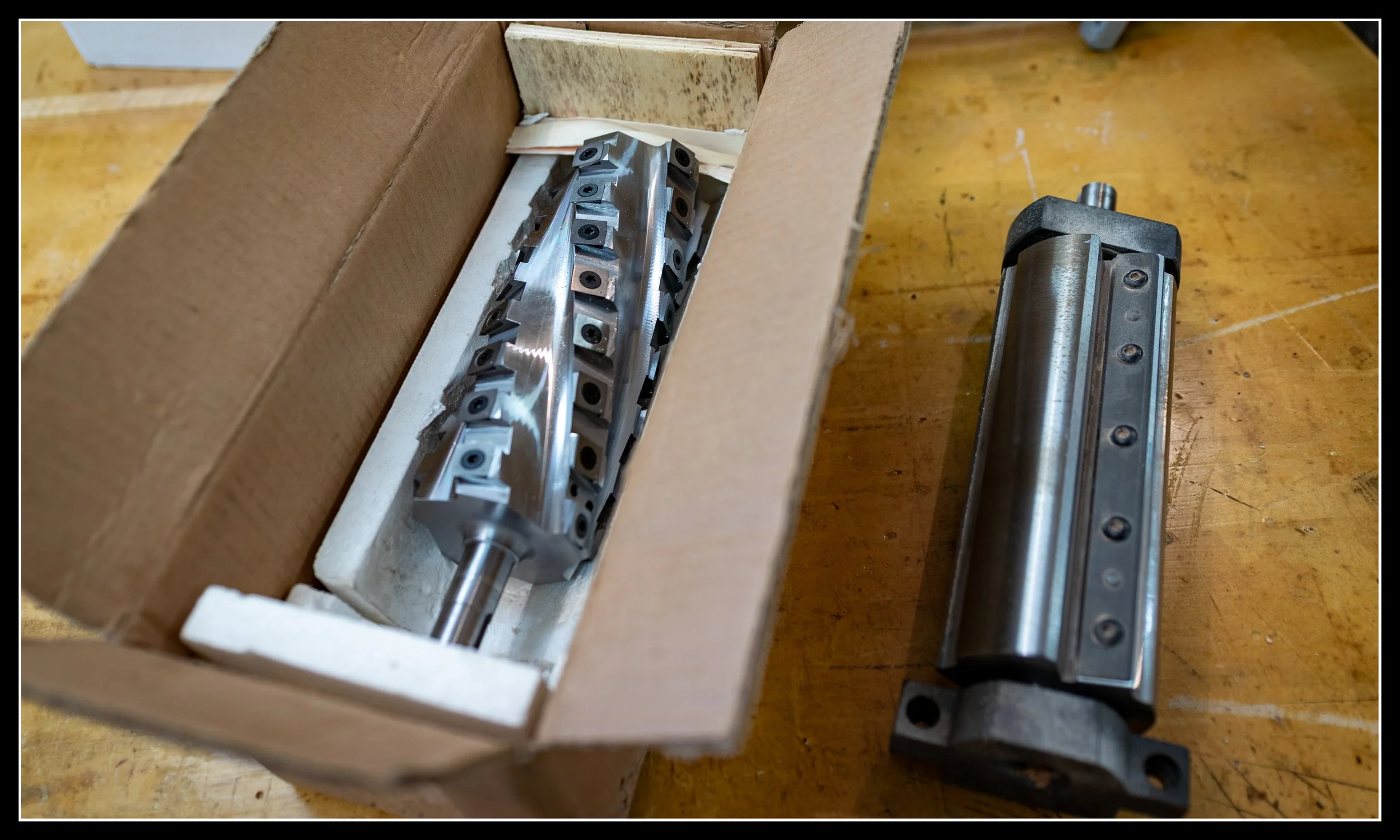
Cutterhead Comparison — Old Steel City vs New Carbide Helical
This bench shot shows the two cutterheads side by side during the upgrade: the original Steel City straight‑knife head and the new carbide helical head waiting to be installed. It’s a clear look at why the upgrade matters. The old head did its job, but it fought the wood and left imperfections. The helical head is heavier, quieter, smoother, and built for modern milling — every insert cutting cleanly instead of three knives doing all the work. This photo captures the moment the jointer stepped into a new level of performance.
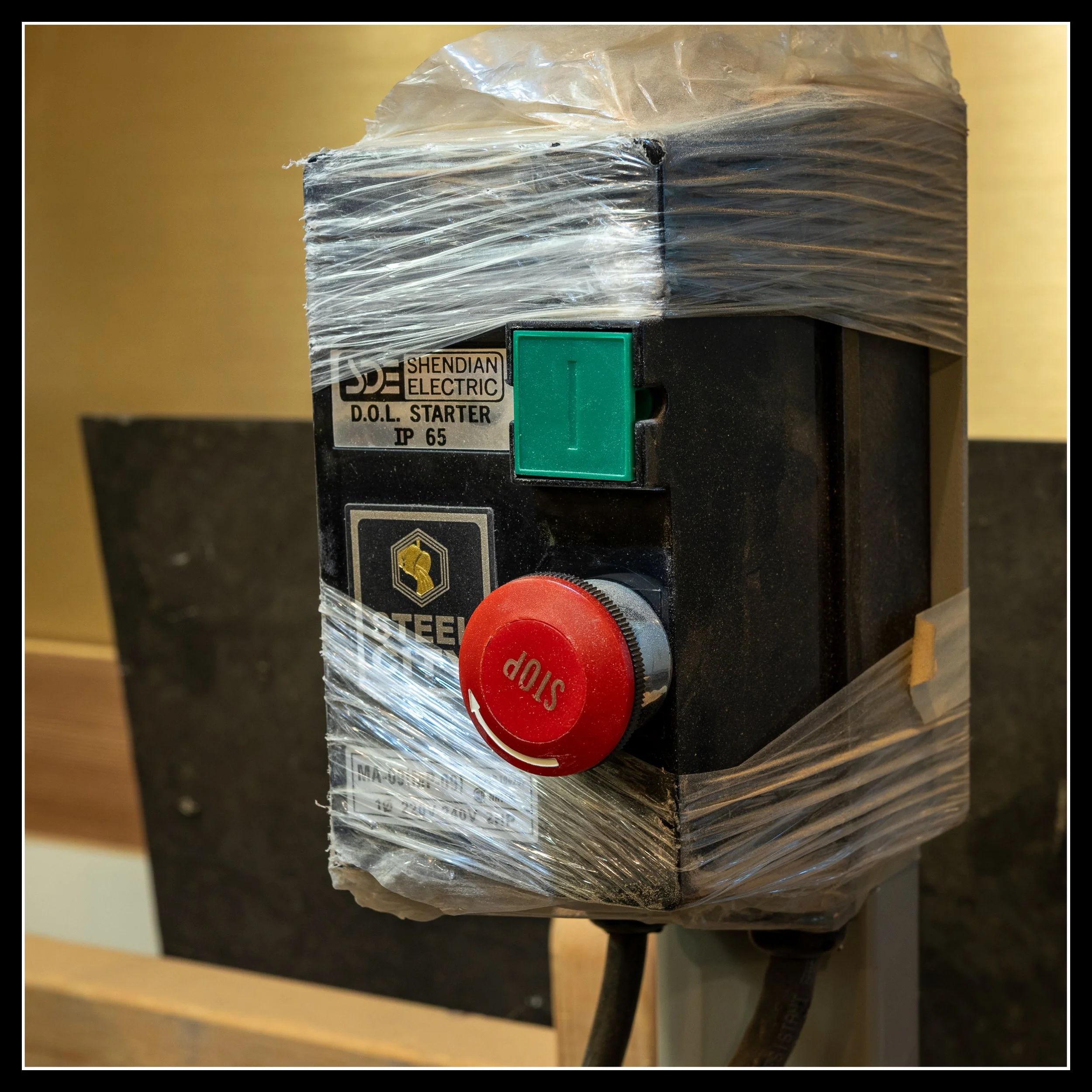
Power Switch — Proof This Jointer Lives in a Real Shop
This is the power switch on my Steel City 8" jointer — complete with a scar from a run‑in with some red oak one busy afternoon. Nothing dramatic, nothing worth fixing. It’s just the kind of mark a machine earns when it actually gets used. This jointer doesn’t live in a showroom; it lives in a woodworking environment where lumber misbehaves, accidents happen, and tools keep working anyway. A small reminder that real shops leave real evidence.
What a Jointer Actually Does (The Straight Facts)
A jointer creates a flat reference face and a straight, square edge. That’s its entire job — and it’s the foundation of every woodworking project that needs accuracy.
It DOES flatten a board. A jointer removes twist, cup, bow, and crook. It creates the first true face.
It does NOT make faces parallel. That’s the planer’s job. A jointer flattens; a planer matches.
It DOES straighten edges. The jointer produces edges that are square to the face and safe for the table saw.
It does NOT control thickness. A jointer doesn’t care how thick the board is — only whether it’s flat.
It DOES create the reference surface every other machine depends on. Without a flat face, the planer can’t do its job. Without a straight edge, the table saw becomes dangerous.
It does NOT replace a planer. A jointer fixes the shape. A planer fixes the thickness. They are partners.
The simple truth
A jointer’s job is flat + straight.
A planer’s job is parallel + thickness.
Together, they turn rough lumber into real woodworking material.
Together, gathered in one place so the machine stories, tool reflections, and workflow moments stay connected — easy to find and easy to return to.
SHARE
The Working Side of the Craft — Connected Through Machines, Tools & Stories
If you want the stories shaped by table saws, bandsaws, grinders, fences, and jigs — the honest, noisy side of woodworking — the Working Side Of The Craft is one click away.
If you’d like to hear from me only when something big is happening — a launch, a milestone, or a major project — you can join the mailing list below.
Written by David Flather, Red Seal cabinetmaker and founder of Knotty Dave’s Fine Woodworking — a Manitoba shop rooted in heritage restoration, storytelling, and real craft.
All photos shot by David Flather — in the shop, on the road, and in the places where craft and story meet.
Related stories:
Shop Life — The Humour, Frustration, and Timing of a Working Day
Woodworking After 50: How Experience, Patience, and a Personal Shop Redefine the Craft
Why Woodworkers Never Have Enough Clamps: The Truth About F‑Clamps
The Workshop Library
If you enjoyed this story, there’s lots more like it inside The Workshop Library — and it’s free to explore.
Wood Archive — species, grain, working properties, and real‑world craft notes
Behind the Grain — the deeper stories inside wood, craft, and heritage
The Working Side of the Craft — tools, shop life, workflow, and the realities of making
Digital to Sawdust — Design Studio — geometry, proportion, visual flow, and design thinking
The Stories of the Shop — the personal side of craft, the shop’s history, and the quiet moments that shape the work
House & Hearth — heritage home restoration, the hearth room, winter culture, and the lived‑in side of craft
I’m just one man with a shop, building this archive one story at a time. If you’d like to follow the journey as it unfolds, explore The Workshop Library — new stories every week.
