

🍁 Hard Maple
Quick Answer — What Makes Hard Maple So Strong
Hard maple is the dense, pale hardwood that comes from sugar maple — a northern tree shaped by slow growth and freeze–thaw seasons. Its tight grain and closed pores make it smooth, strong, and clean‑working, but its hardness demands sharp tools and careful machining. Reliable in furniture, flooring, and high‑traffic surfaces, hard maple stays true under load, yellows as it ages, and prefers life indoors.
Slow‑grown northern hardwood shaped by freeze–thaw cycles
Tight grain that creates dense, pale, uniform lumber
Closed pores that resist grime and finish contamination
High hardness that dulls blades and demands sharp tools
Sugar maple only — the single true hard maple in North America
Maple yellows over time and doesn’t like weather
🍁 Hard Maple — Northern Strength, Tight Grain, and the Freeze–Thaw Hardwood
Hard maple comes from one tree—the sugar maple—and its strength comes from slow growth, tight grain, and the freeze–thaw rhythm of the northern forests. Dense, pale, and uniform, it’s one of the most reliable hardwoods in the shop.
BY THE END OF THIS STORY
You’ll understand hard maple as the slow‑grown northern hardwood shaped by freeze–thaw cycles, why sugar maple is the only true hard maple in North America, how tight growth rings create dense, pale, uniform lumber, and why maple burns, dulls blades, and demands sharp tools. You’ll also see how maple syrup connects to the same freeze–thaw rhythm, why northern climates produce the best maple, and how hard maple behaves in furniture, flooring, machining, and finishing.
Estimated read time: 9 minutes
Fast Summary
Hard maple is the slow‑grown northern hardwood shaped by freeze–thaw cycles — dense, pale, tight‑grained, and uniform. Sugar maple is the only true hard maple in North America, producing closed‑grain lumber that resists grime, holds an edge, and demands sharp tools. It burns easily under dull blades, machines clean under sharp ones, and excels in furniture, flooring, gym surfaces, and high‑traffic areas. Hard maple is strong, smooth, and reliable — but it yellows over time and doesn’t like the weather.
Comparison — Hard Maple vs Soft Maple
Soft Maple — Lighter, Faster‑Grown
Wider growth rings
Softer wood
More colour variation
Easier to machine
Good for interior trim and lighter furniture
Hard Maple — Dense, Pale, Northern
Tight grain
Closed pores
High hardness
Uniform colour
Best for furniture, flooring, gym surfaces
Soft Maple Strengths
Easier on tools
Less prone to burning
More forgiving to machine
Often more affordable
Hard Maple Strengths
Closed grain resists grime
Excellent for high‑traffic surfaces
Holds an edge
Polishes to a soft reflection
Bottom Line
Hard maple is the northern hardwood built for strength, density, and precision. Soft maple is the lighter, faster‑grown cousin — easier to work, but not as strong.
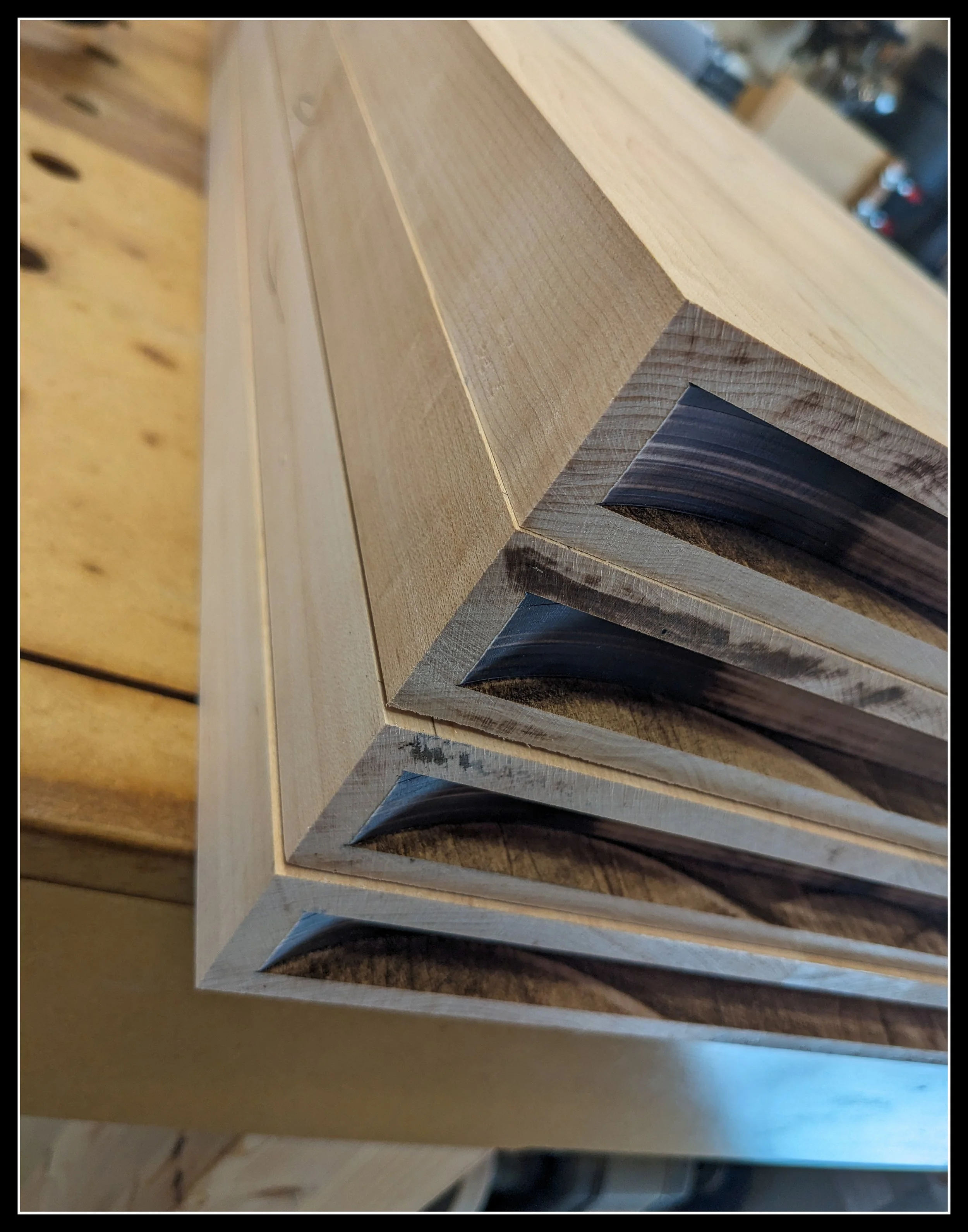
Solid Maple Shelving — Built to Hold Its Own
Solid hard maple doesn’t ask for permission. It carries weight the way northern hardwoods always have — quietly, confidently, and without sagging under the load. These shelves aren’t veneer, they aren’t engineered, and they aren’t pretending to be strong. They are strong. Clean bevels, tight grain, and joinery that feels like it was made for a lifetime of use. Maple has that particular honesty: once you shape it right, it stays shaped. Once you put it to work, it keeps working. These shelves will hold whatever you throw at them, and they’ll still look good doing it.
🍁 Hard Maple — Northern Strength, Tight Grain, and the Freeze–Thaw Hardwood
I didn’t grow up with maple. It came to me later, when I was a young cabinetmaker with tools spread across the benches and sawdust clinging to my clothes and beard. In the heat of July the shop would fill with that sweet, woodsy smell, drifting into all four corners and settling into my memory. I’m sitting here now, far from the shop, but the scent still hangs in my mind like an old friend helping me put this story together.
🍁 Hard Maple vs Soft Maple
There are several species of maple in North America. Most of them—bigleaf maple, red maple, silver maple, boxelder—are fast‑growing pioneer trees. They rush into disturbed ground, grow quickly, and don’t live long. Their wood is lighter, softer, and more variable. In the trade we group them together as soft maple.
But this article is about hard maple.
🍁 Hard Maple — The Sugar Maple
Hard maple comes from one tree: the sugar maple. It’s the only maple on this continent that evolved to play the long game—slow growth, long life, tight grain, and dense, stone‑like wood. This is the maple we work with in the shop. This is the one that burns on the jointer, sings under a sharp plane, and holds an edge like few other hardwoods. This is Hard Maple.
🍁 Hard Maple and the Freeze–Thaw North
Sugar maple evolved on the eastern side of North America, from Canada down into Tennessee, but it performs best in cold northern climates. That’s where it produces its finest lumber and its sweetest syrup. The warmer the climate, the longer the growing season, and long seasons mean wider growth rings and more colour variation. Wider rings make softer wood. Hard maple is only truly “hard” when winter slows it down.
Maple is unique because it evolved to use the freeze–thaw cycles of the northern spring. Each night the temperature drops below freezing and the outer layers of the tree freeze. The sap inside is pushed downward under pressure. When the morning warms and the tree thaws, the sap rises again toward the upper branches. This cycle repeats for weeks, and the tree’s anatomy is built around it.
That rhythm—freeze, thaw, freeze, thaw—creates tight growth rings in northern‑grown sugar maple. Tight rings mean dense earlywood and dense latewood, with very little contrast between them. The result is a pale, uniform hardwood with a smooth texture that can be polished to a soft reflection. That’s hard maple. That’s the northern tree we work with in the shop.
🍁 Bird’s‑Eye, Curly, and Quilted Maple
Bird’s‑eye maple and curly maple both come from sugar maple—they’re not separate species, just rare grain phenomena that appear in a small percentage of trees. Quilted maple, on the other hand, is almost always bigleaf maple from the West Coast. Hard maple gives us bird’s‑eye and tight curl; soft maple gives us quilt. These figures come from stresses in the tree, irregular growing conditions, and in the case of bird’s‑eye, causes we still don’t fully understand. When these features do appear, they make the wood far more valuable, often cut into veneer or sold as premium solid boards.
🍁 Northern Hard Maple — Managed, Not Farmed
Sugar maple is managed, but not farmed. It grows in mixed hardwood forests under long rotations, harvested selectively after decades of slow growth. Plantation maple exists, but the best hard maple still comes from natural northern forests.
🍁 Maple Syrup
You can’t talk about sugar maple without talking about syrup. First off, the sugar maples harvested for lumber are not tapped. A tapped tree is pierced every spring, and even though the wounds heal, they leave dark tap stains and internal scars that reduce lumber quality. Lumber trees need clean, uninterrupted growth so the sap can be used by the tree to build wood, not collected for syrup.
Other stands—managed sugarbushes—are the maple syrup forests of Canada. These are the trees that carry the blue tubing and buckets each spring. And that same freeze–thaw cycle I mentioned earlier is exactly what makes the best maple syrup in the world. Cold nights freeze the outer layers of the tree, compressing the sap downward. Warm days thaw the tree and pull the sap back upward. That pressure swing is what drives sap flow, and no other climate on Earth does it as consistently or as cleanly as the Canadian spring. Producing the best maple syrup in the world. Marketed as Canadian Maple Syrup.
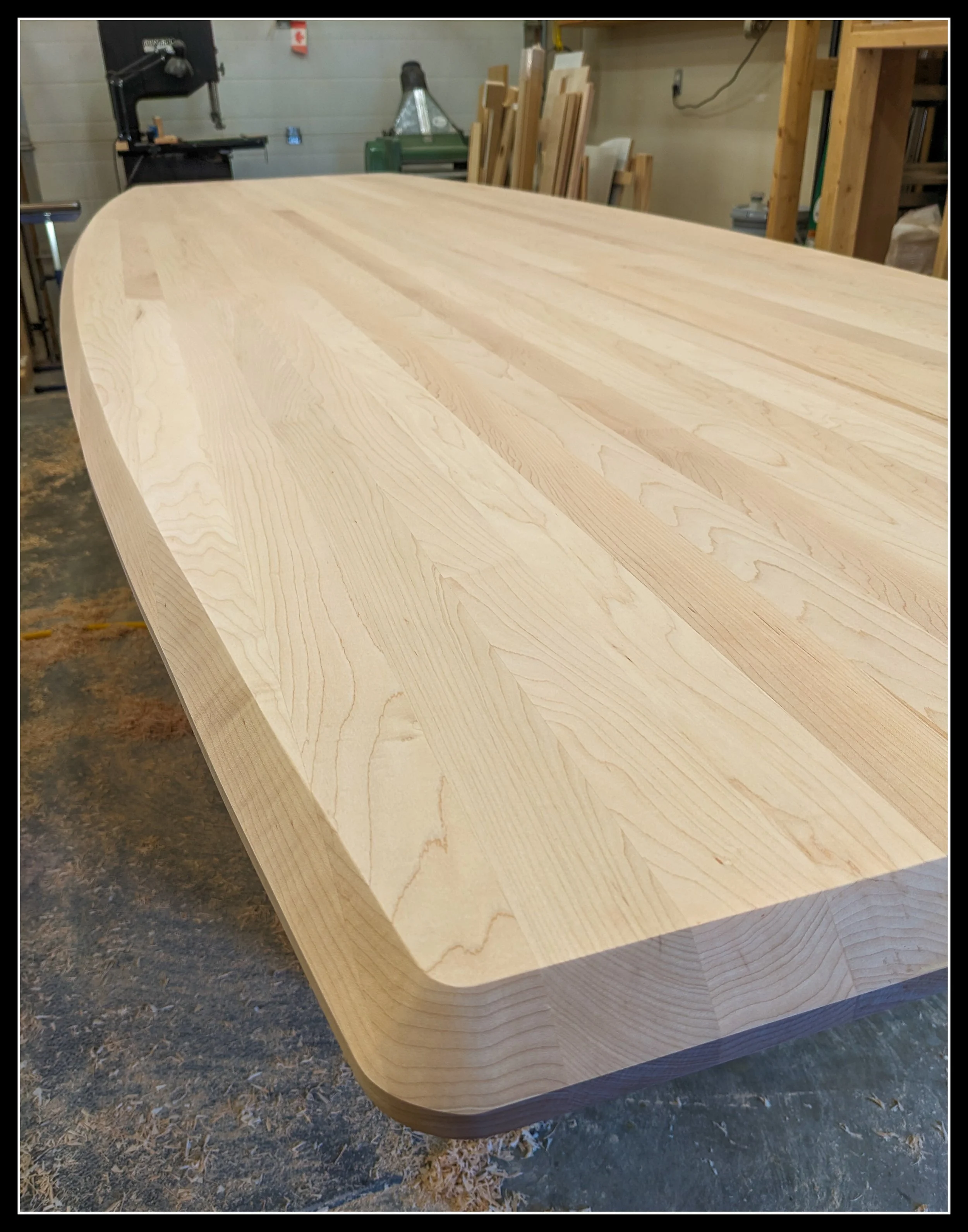
Hard Maple Tabletop — Upside Down and Still Beautiful
Hard maple doesn’t need finish to show what it is. Even flipped upside down on the bench, the wood carries its own quiet shine — tight grain, pale colour, and that unmistakable weight you only get from a tree that grew slow in a northern climate. This top isn’t sanded out, it isn’t oiled, and it isn’t polished. It’s just honest maple, joined clean and shaped true, already looking like a piece that will outlast the room it’s built for.
🍁 Northern Hard Maple — Not a Canadian Label
Canada doesn’t market hard maple as “Canadian Hard Maple” because the hardwood trade is regional, not national. The premium label is “Northern Hard Maple,” which includes both Canadian and northern U.S. forests. But make no mistake—the cold Canadian climate produces some of the hardest, palest, tightest‑grained maple on the continent.
🍁 Maple in Use
Have you ever sat at a restaurant table that’s clean but still feels sticky? That’s usually red oak. Red oak is an open‑grain wood with large pores, and those pores act like tiny cups that hold grease, oil, and spills. Even with a finish on top, a high‑traffic table wears down fast, and once the finish thins out, the pores start absorbing everything. That’s why the surface feels tacky no matter how much it’s wiped. Red oak just isn’t the best choice for restaurant tables.
Hard maple is. Hard maple is a closed‑grain wood—the pores are tiny and evenly distributed, so the surface stays smooth and doesn’t trap grease. It actually cleans off. A maple tabletop won’t get that sticky feeling unless the finish is completely neglected. And even then, the wood itself isn’t holding the grime; it’s just the worn finish. Hard maple gives restaurants a fighting chance at keeping tables clean.
🍁 Machining Maple
That closed‑grain nature and uniform hardness make maple one of those woods that will dull blades and knives in the shop. If I’m starting a big project, I always begin with freshly sharpened blades and new planer knives. Maple rewards sharpness and punishes anything less.
Its smooth surface also loves to stick to jointer and planer beds, which makes the work harder than it needs to be. So I keep the beds of those machines—and the table saw—clean and waxed. Reducing friction is half the battle with maple.
The hardness and tight grain also make maple prone to burning when it’s being cut. Dull blades, dirty beds, slow feed rates—they all build heat, and heat is what causes burns, kickback, and tear‑out. Sharp tools and slick machine beds aren’t optional with maple; they’re the difference between clean work and a fight. That goes for all woods—safety first—but I feel it more when machining maple. Burning means more sanding, so let’s not burn.
Maple’s strengths show up in the finished work. That closed grain and uniform hardness make it one of the best woods for high‑traffic areas. It’s why gym floors are maple. It’s smooth, it cleans well, and it holds up. It’s great for chairs and cabinetry, butcher blocks and trim. But it’s an indoor wood—that’s its weakness. Maple doesn’t like the weather. And over time, even indoors, maple will yellow into a warm, aged tone. That’s just what it does.
🍁 Closing
Well, there you have it—hard maple. It’s taken a little while to write this, but that smell that drifts up from deep memory on hot summer afternoons stayed with me right to the end. If you’re unfamiliar, it’s a bit like the smell of toast, but woodsy, warm, and clean. For a moment I thought it was memory doing the work, but no—someone toasted a bagel earlier. Maybe it was both. Maple has a way of lingering like that.
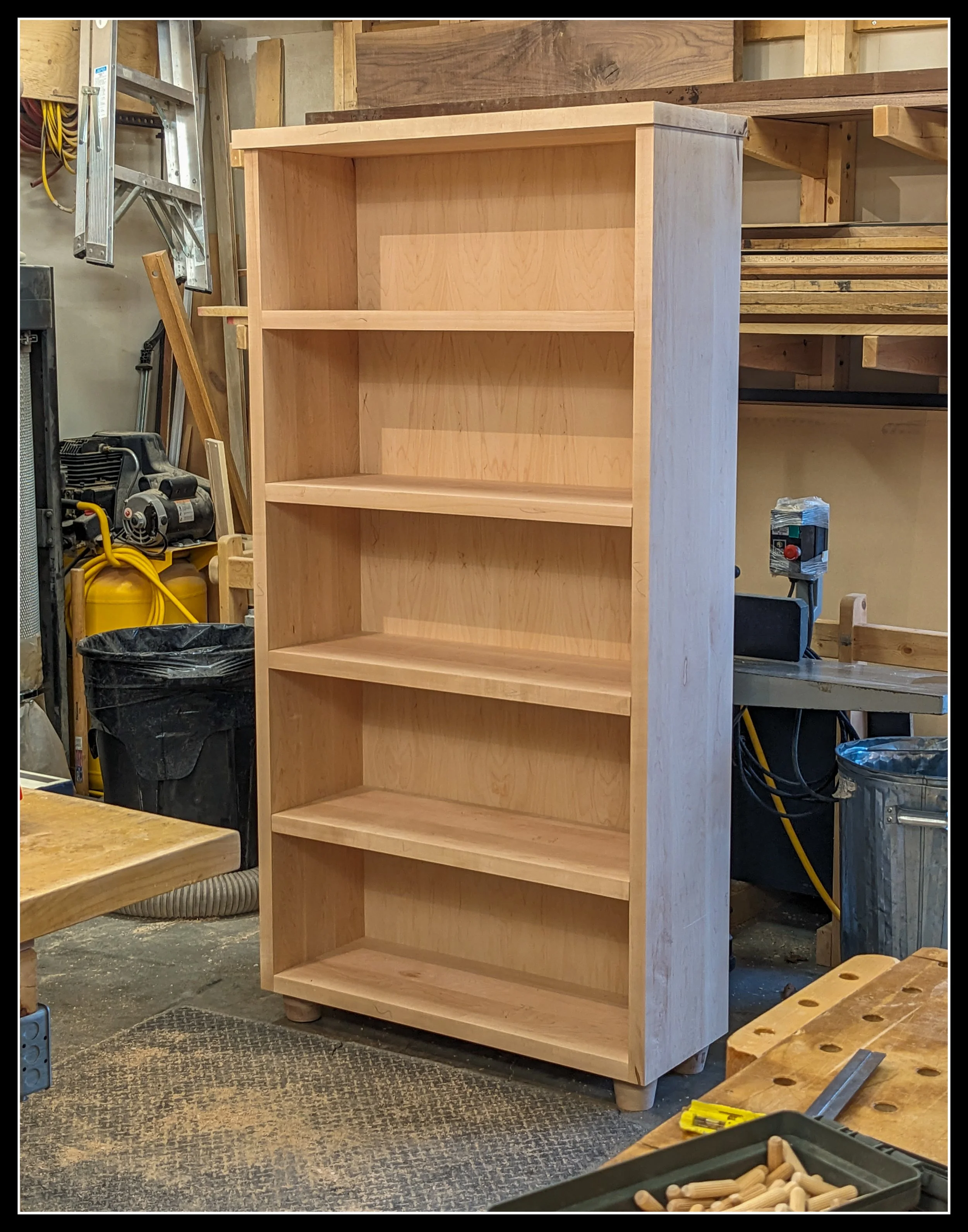
Solid Maple Vinyl Record Shelving — Built for Real Weight
Vinyl doesn’t lie. If a shelf is weak, it shows you fast. That’s why this unit is solid hard maple from top to bottom — real boards, real joinery, and turned maple feet that carry the load without complaint. No finish yet, no polish, nothing hiding the work. Just clean lines, tight grain, and the kind of strength you only get from northern hardwood shaped the right way. These shelves won’t sag, won’t twist, and won’t give up when the records start adding up. Maple has always been a working wood, and this piece is exactly what it was meant for: holding weight, staying true, and looking good while it does it.
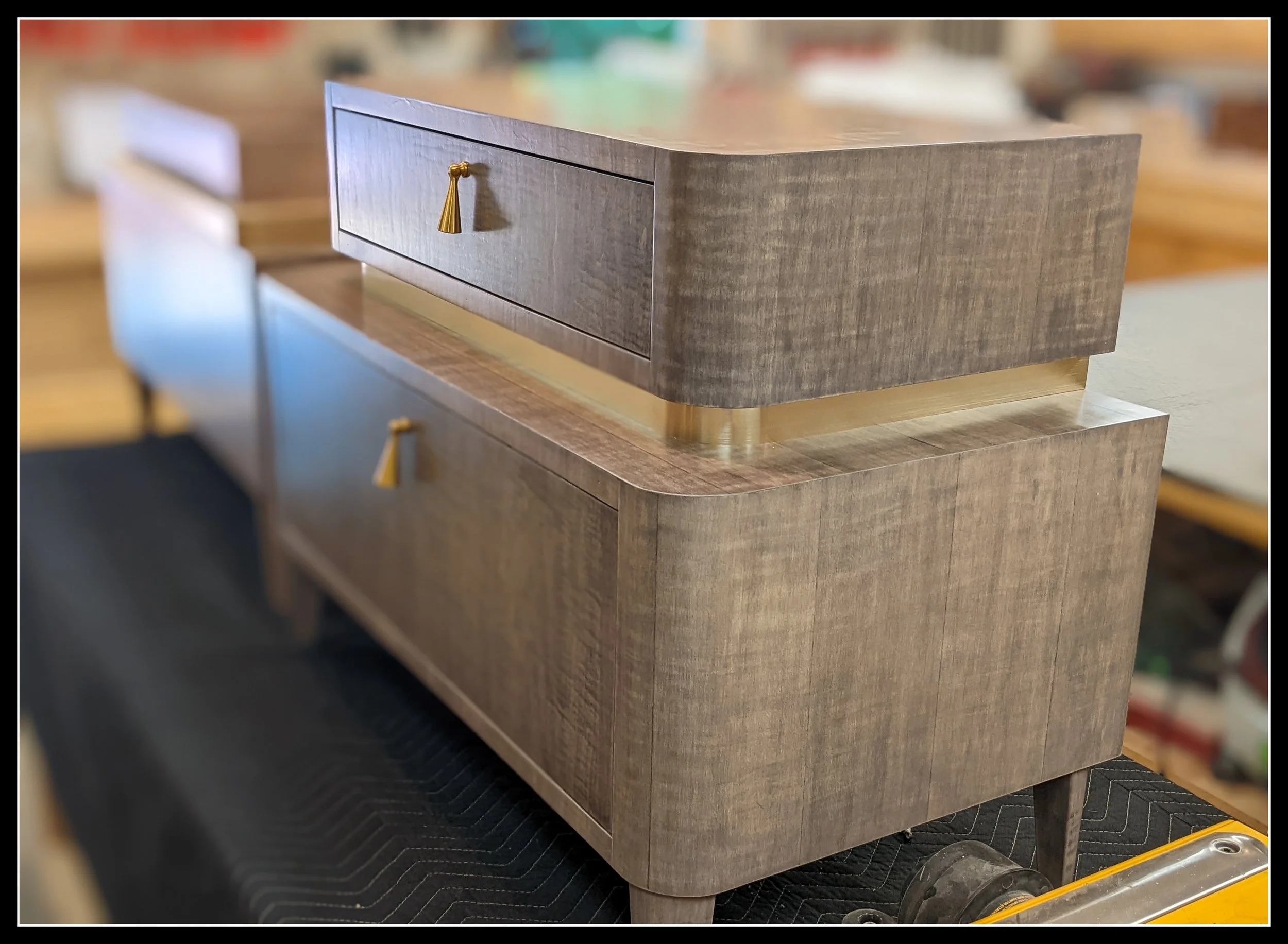
Figured Maple Nightstands — Veneer, Brass, and Solid Maple Feet
Figured maple has a way of stealing the light, even before finish. These nightstands show it clearly — the grain shifting like fabric, the veneer laid clean, the brass accents catching just enough glow to make the whole piece feel intentional. The drawer pulls, the divider line, the proportions… everything sits in balance. And underneath it all, the feet are solid maple, turned by hand, carrying the weight the way good hardwood always does. No finish yet, no polish, nothing hiding the work. Just honest materials shaped into something that feels both modern and rooted in the craft.
🍁 Deep Scraped Hard Maple — Grain, Light, and Northern Clarity
Hard maple carries its own kind of brightness — pale colour, tight grain, and a northern density that holds every detail you put into it. These Deep Scraped Collection finishes push that clarity further, using brushed grain, layered stain, glaze, and 2K poly to bring out the subtle texture maple hides under its smooth surface. Maple doesn’t shout; it reveals. Scraping opens the earlywood just enough to catch the light, stain warms the pale tone without muddying it, and glaze settles into the grain with a softness only hard maple can pull off. Maple has always been a northern hardwood built for precision, and under texture it becomes something else entirely — clean, bright, and quietly dramatic.
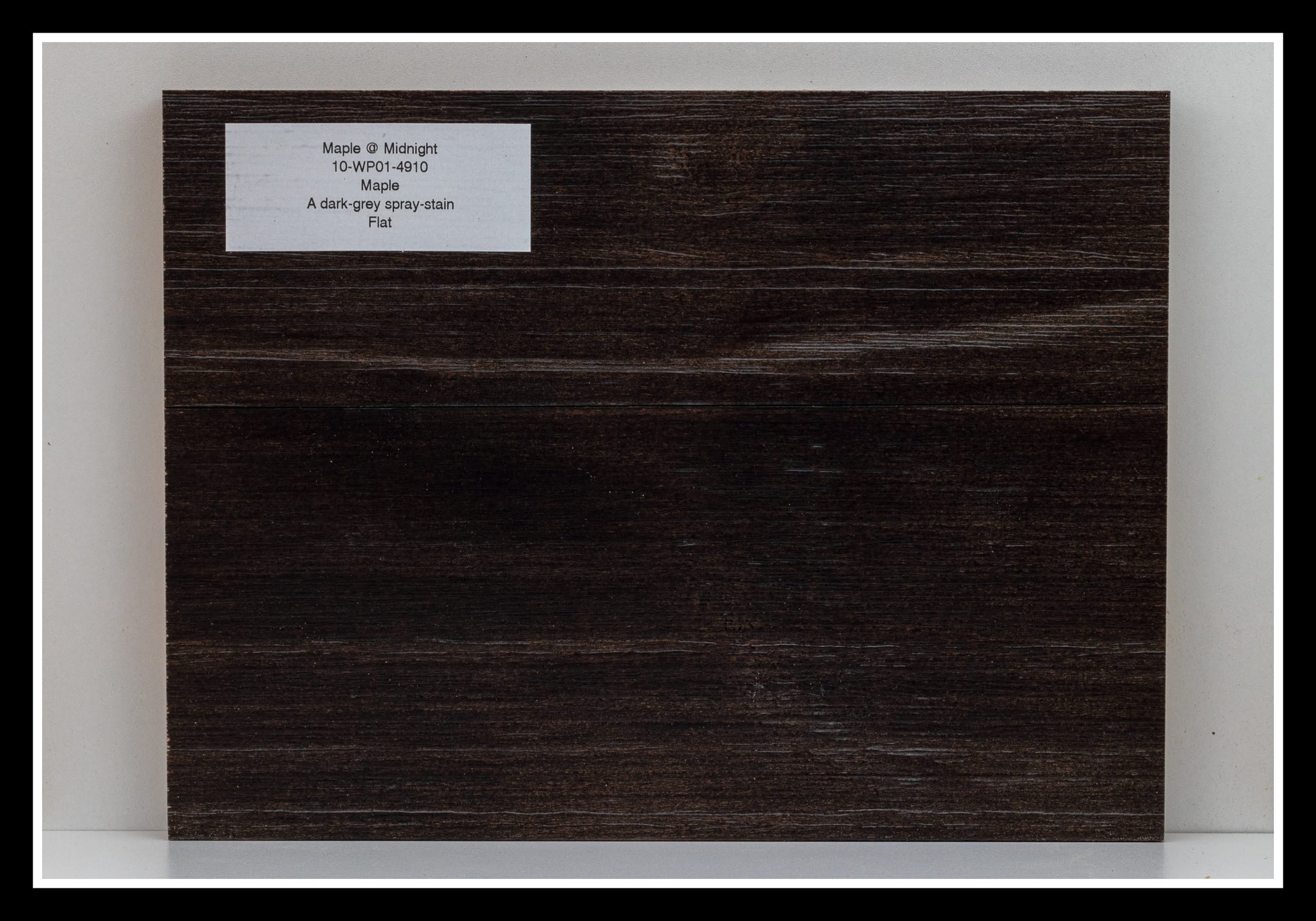
Maple @ Midnight — Dramatic Grain in a Northern Wood
Maple @ Midnight is maple pushed into its dramatic side — brushed deep, stained dark, glazed for shadow, and sealed under a 2K poly that gives the whole surface a quiet, midnight calm. Hard maple is usually a subtle wood, pale and tight‑grained, but scraping opens the earlywood just enough to catch the glaze, and the stain pulls the colour into a tone you’d never expect from maple. The grain comes alive under the texture, shifting between light and shadow like moonlight on water. Maple can be bold when you ask it to be, and this finish proves it.
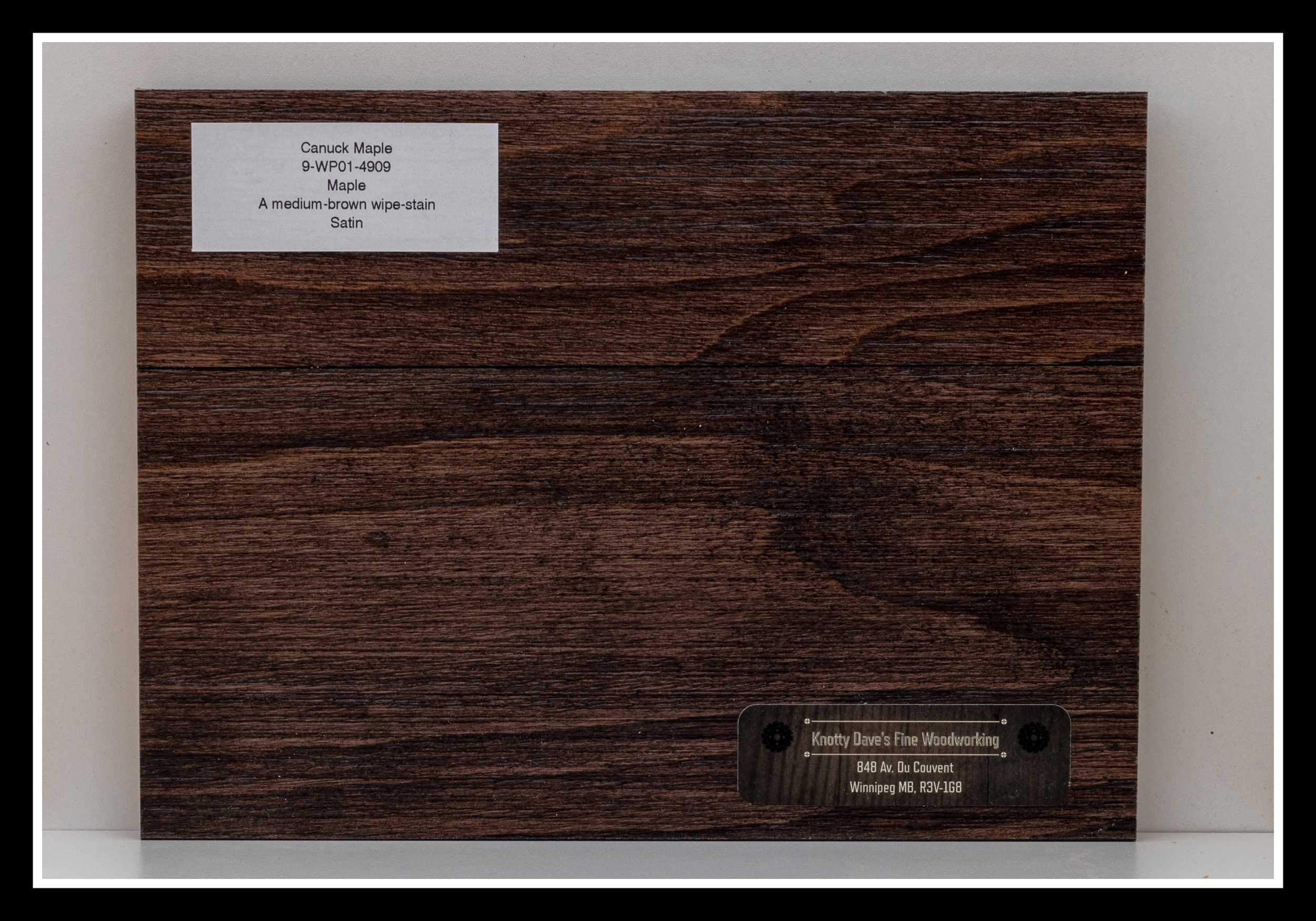
Canuck Maple — Rugged Maple With an Elegant Edge
Canuck Maple is brushed hard, stained warm, glazed for depth, and sealed under a satin 2K poly that gives the whole surface a clean, confident glow. Hard maple is usually subtle — pale, tight‑grained, northern — but this finish pulls out its tougher side. It’s elegant, but rugged. It feels like hockey in July, street hockey, someone yelling CAR! before the game slides back into place. The brushing opens the earlywood just enough to catch the stain, the glaze settles into the grain with a warm shadow, and the topcoat keeps everything smooth without losing the texture. This is maple with attitude — still refined, still northern, but carrying a bit of Canadian grit.
Where every species, every board, and every lesson in wood science comes together — a place to explore the materials that shape our craft.
SHARE
The Wood Archive — All the wood Stories in One Place
For the living side of woodworking — the stories shaped by walnut, oak, maple, cherry, elm, cedar, and poplar — head to the Wood Archive.
If you’d like to hear from me only when something big is happening — a launch, a milestone, or a major project — you can join the mailing list below.
Written by David Flather, Red Seal cabinetmaker and founder of Knotty Dave’s Fine Woodworking — a Manitoba shop rooted in heritage restoration, storytelling, and real craft.
All photos shot by David Flather — in the shop, on the road, and in the places where craft and story meet.
Related Stories:
Pine Wood Explained: Eastern White Pine and the Family of Fire‑Adapted Trees
Ash Trees: Green, White, Black, and the Emerald Ash Borer Threat
Oak vs Oak: How White Oak and Red Oak Shaped Homes Across the Decades
Hickory Wood: Strength, Shock Resistance, and Why It’s Tougher Than Oak or Ash
The Workshop Library
If you enjoyed this story, there’s lots more like it inside The Workshop Library — and it’s free to explore.
Wood Archive — species, grain, working properties, and real‑world craft notes
Behind the Grain — the deeper stories inside wood, craft, and heritage
The Working Side of the Craft — tools, shop life, workflow, and the realities of making
Digital to Sawdust — Design Studio — geometry, proportion, visual flow, and design thinking
The Stories of the Shop — the personal side of craft, the shop’s history, and the quiet moments that shape the work
House & Hearth — heritage home restoration, the hearth room, winter culture, and the lived‑in side of craft
I’m just one man with a shop, building this archive one story at a time. If you’d like to follow the journey as it unfolds, explore The Workshop Library — new stories every week.
