

Anchor Lines — The Quiet Guides Inside Every Good Design
Quick Answer: What are anchor lines?
Anchor lines are the lines your eye follows without thinking — the edges, curves, and shapes that guide how you look at a room or a piece of furniture. They’re the quiet details that make a design feel calm, balanced, and intentional.
What You’ll Learn
how anchor lines direct the eye
how horizontals and verticals build rhythm
how curves soften a room’s emotional tone
how photography and design share the same vocabulary
how to see the quiet geometry inside any space
A designer’s guide to anchor lines, visual flow, and the quiet geometry that shapes every room and photograph
Some designs feel beautiful the moment you see them — a room that feels calm, a photograph that feels intentional, a piece of furniture that feels balanced. The difference isn’t luck or expensive materials; it’s anchor lines. These are the quiet guides your eye follows: the horizon created by a countertop or crown molding, the vertical rhythm of stiles and columns, the curve that softens a rectangular room, or the contrast boundary where light meets shadow. They exist in photography, furniture geometry, and room design, all sharing the same vocabulary.
BY THE END OF THIS STORY
You’ll understand how anchor lines guide the eye, shape emotional flow, and connect photography, furniture geometry, and room design into one unified visual language.
Estimated read time: 7 minutes.
Fast Summary
Anchor lines are the quiet guides inside every good design — the directional cues your eye follows through a room, a photograph, or a piece of furniture. They include horizontals that stabilize, verticals that build rhythm, curves that soften, and contrast boundaries that define shape. This story explains how anchor lines connect photography and furniture geometry into one visual language, why they make designs feel intentional, and how learning to see them transforms the way you build, design, and capture your work.
Why Some Designs Feel Beautiful
Think about something you saw that was beautiful. Now ask yourself: why was it beautiful? How was it beautiful? And contrast that with something that wasn’t. What’s the difference? What separates fine, intentional photography from a quick snapshot? What separates a custom kitchen design from a builder grade kitchen? Both versions function the same, but only one gets framed and hung on a wall. Because proper design can be felt by anyone who has a soul — and that’s what this story is about. How to design a room. How to design a piece of furniture. How to frame a good image in the camera. These things are connected; they work the same. And once you understand how they connect, the whole concept becomes simple. Because at its core, design is simple — and understanding anchor lines is what connects everything we see.
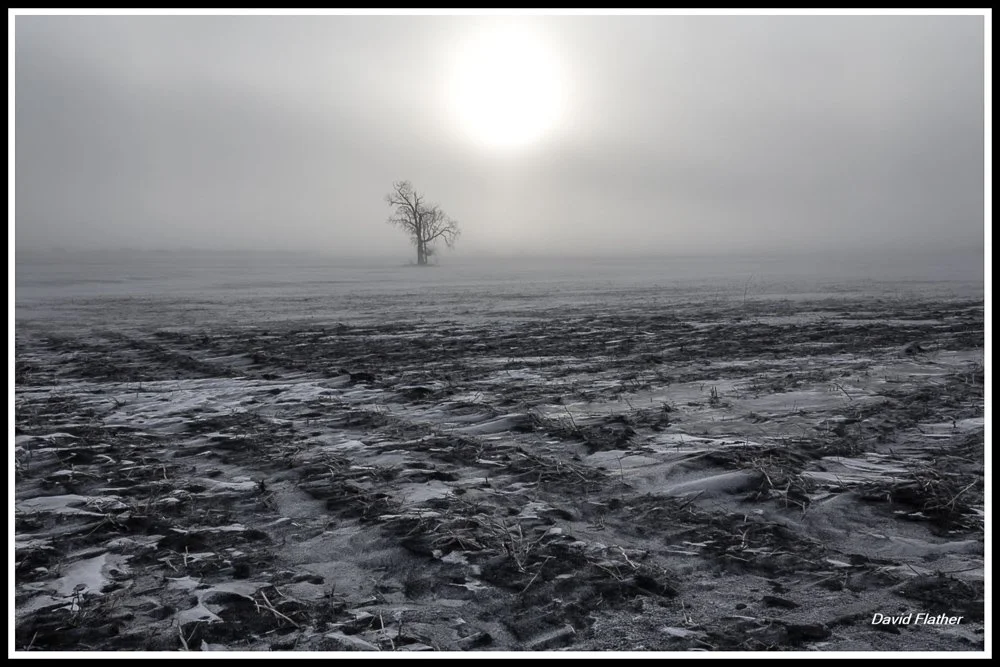
Winter Tree — Anchor Lines in a Storm
A lone tree standing in a winter field is one of the purest examples of anchor lines in nature. Your eye lands on the tree first, then drifts toward the muted sun, then follows the faint lines carved into the soil months earlier. Light, shadow, texture, and direction all work together to pull you deeper into the image. This is the quiet geometry photographers chase — the natural flow that guides the eye without ever announcing itself.
What Anchor Lines Actually Are
Directional Cues Your Eye Follows
Anchor lines are any directional cue your eye follows. Think about an image of a lone tree in a farmer’s field during a winter storm. The sun is still there — muted, softened, just an echo of its full brightness — lost in blowing snow and falling flakes, but still lighting the tree. The world is alive, and your eye settles on the tree first. Then it moves to the muted sun. Then you notice the patterns left by the farmer’s equipment when the soil was turned last fall. Those lines all point back to the tree, and from the tree back to the sun.
Anchor Lines as Natural Flow
There are anchor lines in this photo that draw your eye deep into the image and hold you there long enough to imagine the howl of the wind and the cold in the air. Anchor lines are the natural flow of the world — the lines that draw you in. They can be a beam of light, a contrast in the sky, or a shift in texture from one surface to the next. Once you understand them, it becomes easier to capture them as a photographer, a designer, or a woodworker. It takes practice to capture feeling in a design or an image, but once you see it, you finally understand what you’re trying to capture.
The Shared Vocabulary of Photography & Design
These are the terms that exist in both photography and design, and every one of them is an anchor line. You may have heard or used these terms in the past, all of them are different ways of describing an anchor line as there are different ways of seeing them. But all of them work unified in a design, knowing these terms have a conection brings them together so the concept is easer to see.
Leading Lines
Photography: Lines that guide the viewer’s eye through the frame.
Design: Lines that guide the eye through a room, cabinet wall, or piece of furniture.
Anchor Line: The path your eye naturally follows.
Horizon Line
Photography: The horizontal anchor that stabilizes a landscape.
Design: The countertop line, crown molding line, chair rail line — the “horizon” inside a room.
Anchor Line: The line that creates calm and stability.
Contrast Boundary
Photography: Where light meets shadow.
Design: Where a reveal, bevel, or shadow line breaks a surface.
Anchor Line: The edge your eye locks onto.
Flow
Photography: How the eye moves through an image.
Design: How the eye moves through a room or across a piece of furniture.
Anchor Line: The direction of movement.
Composition
Photography: The arrangement of shapes, light, and subject.
Design: The arrangement of cabinets, furniture, shapes, and geometry.
Anchor Line: The structure beneath the arrangement.
Balance
Photography: Visual weight distribution in a frame.
Design: Visual weight distribution in a table, pedestal, cabinet, or room.
Anchor Line: The line that divides heaviness and lightness.
Negative Space
Photography: The empty areas that give the subject room to breathe.
Design: The gaps, reveals, and spacing that make furniture feel intentional.
Anchor Line: The space that defines the line.
Rhythm
Photography: Repeating shapes or tones that create flow.
Design: Repeating doors, drawers, panels, or columns.
Anchor Line: The repeated line that creates calm.
Framing
Photography: Using shapes or light to frame the subject.
Design: Using geometry to frame a cabinet, table, or architectural feature.
Anchor Line: The boundary that directs attention.
Perspective
Photography: The angle that shapes how the subject is seen.
Design: The angle that shapes how a piece feels in a room.
Anchor Line: The directional cue created by viewpoint.
Texture
Photography: Texture is revealed by directional light.
Design: Texture is revealed by shadow lines, bevels, and geometry.
Anchor Line: The shift in surface that guides the eye.
Depth
Photography: Depth created by light, shadow, and perspective.
Design: Depth created by reveals, layers, and shadow lines.
Anchor Line: The line that separates layers.
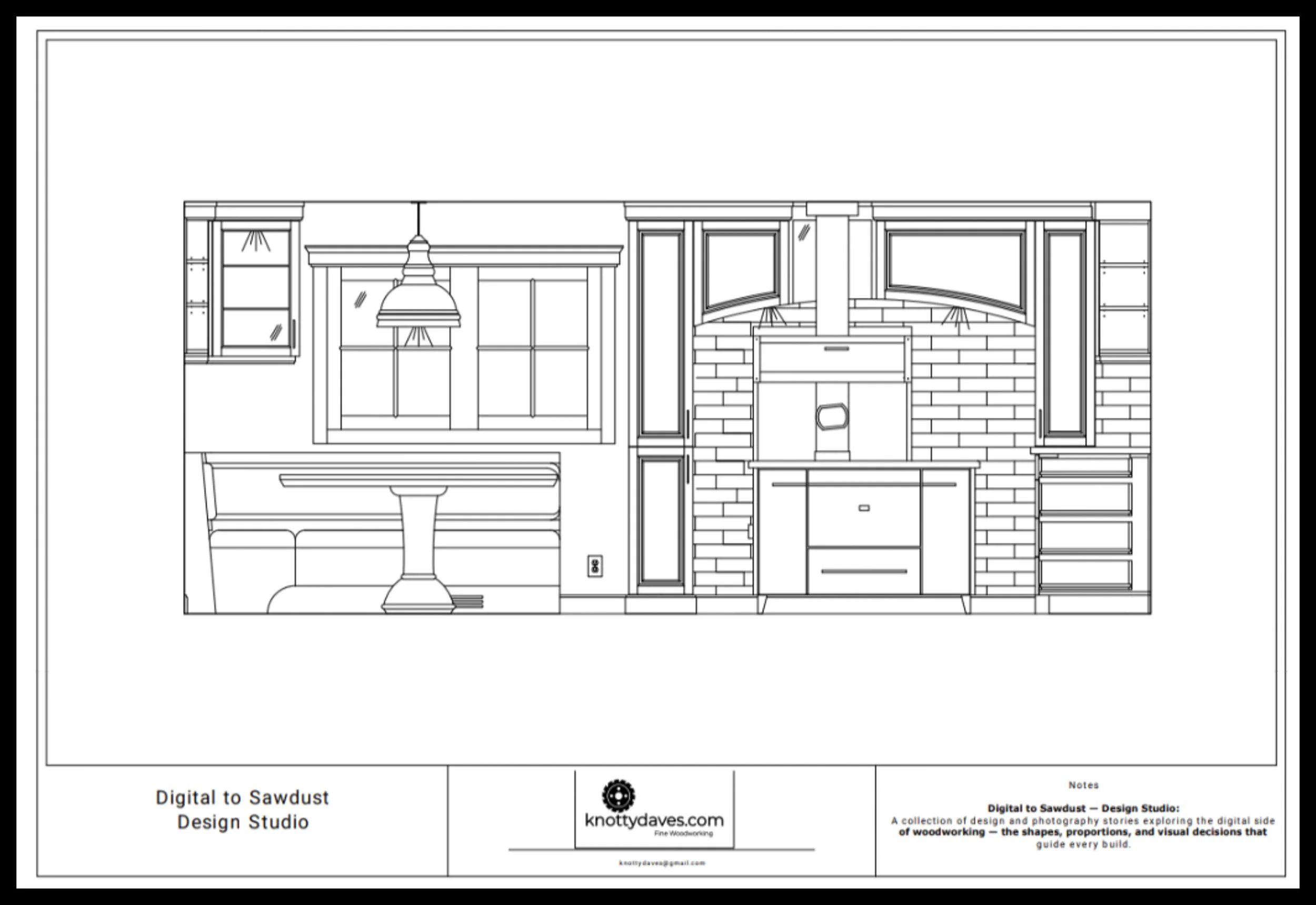
Cookstove Room — Anchor Lines in a Heritage Space
This drawing shows how anchor lines shape a room long before any boards are cut. The arch frames the cookstove, the banquette pulls your eye toward the window, and the table, lamp, and cabinetry all sit on quiet geometric paths that guide the flow of the space. Even in a simple line drawing, the room already feels intentional — every element placed with purpose, every line carrying the story forward.
Anchor Lines Inside a Room
Horizontal Anchor Lines
Anchor lines are simply the elements that draw the eye, could be a beam of light from a sconce on a wall, an S — curve of a river as it leads off to the horizon, the silhouette of a backlit chair in a room. It could be the shape of a piece of furniture, the way its visual weight is split, a taper of a chair leg that directs the eye, a crown on kitchen cabinets that leads the eye around the room. Even sunlight from a window and the shadows created can create an unexpected anchor line.
Anchor lines in design are the lines that repeat — the quiet geometry that builds a room. Horizontal lines stack like layers: crown moulding, light valances, countertops, baseboards, chair rails, window sills, door headers, shelf lines, and ceiling beams. These horizontals complement one another — they create the visual horizon of a room.
Vertical Anchor Lines
Vertical lines do the same. They build the upright rhythm: columns, door jambs, window mullions, window casings, cabinet stiles, tall pantry uppers, furniture legs, chair backs and slats, balusters, door panels, posts and supports, and even lighting fixtures and curtain panels. These verticals are the room’s columns — the lines your eye climbs.
Curved Anchor Lines
Together, these horizontal and vertical lines form the leading lines that direct the eye. They travel the room, intersect, and separate themselves through shadow, colour, and texture. Fabric, hardwood, glass, paint, light, shadows, granite — every material adds its own anchor line, its own cue, its own way of guiding the eye.
Curves are the final layer of anchor lines. A simple piece of hardware, the arc of a chair back, a round table, or a dramatic archway — curves soften the grid and give a design movement. They break the strict horizontals and verticals just enough to make a room feel alive. Once you start seeing how these elements communicate — the lines, the shadows, the textures, the curves — you begin to understand what gives a design its soul. It takes time for your eye to learn this, but every moment you spend practicing design, photography, or woodworking sharpens that sense.
How Anchor Lines Give Design Its Soul
The Geometry Beneath Everything
What is an anchor line? It’s the arrow on a sign that says this way — the simplest example of direction you’ll ever see. Your eye follows it without thinking. That’s what anchor lines do.
Design isn’t complicated once you learn how to see. Anchor lines are the quiet guides inside every good design — the lines that hold a room together, the geometry that shapes a piece of furniture, the flow that carries a photograph, the direction that gives a moment its soul. They’re always there, whether you notice them or not.
Learning to See Anchor Lines
The trick is learning to see them, to feel them, to trust them. It’s the geometry of shapes, the visual weight of an object, and the balance that divides a subject with intention. Just pay attention and notice when an image carries feeling, or when a room carries warmth — anchor lines are doing the work.
The Moment It All Clicks
Once you do, the world opens up. Rooms make more sense. Furniture feels intentional. Photography becomes easier. And the craft — your craft — starts to speak with clarity. Anchor lines are simple, but they take time to understand. Practice design. Practice photography. Practice seeing. Because once you see the quiet guides beneath everything, you can finally build and capture work that feels alive — work that carries meaning, work that people can feel, work that lasts.
Digital to Sawdust — Design Studio
Digital tools, layout, and proportion — the design side of woodworking before the sawdust begins.
SHARE
Digital to Sawdust — Design Studio
Lessons in woodworking design, geometry, and digital layout — teaching how furniture is shaped with intention.— head to the Design Studio. Just one click away.
If you’d like to hear from me only when something big is happening — a launch, a milestone, or a major project — you can join the mailing list below.
Written by David Flather, Red Seal cabinetmaker and founder of Knotty Dave’s Fine Woodworking — a Manitoba shop rooted in heritage restoration, storytelling, and real craft.
All photos shot by David Flather — in the shop, on the road, and in the places where craft and story meet.
Related stories:
Profiles in Design: How Light, Shadow, and Edges Shape a Room
Visual Weight in Woodworking: How Proportion Shapes the Feel of Furniture
The Quiet Geometry of Furniture: How Curves Change a Room, Softening Rectangular Design
Photography For Woodworkers: Turning Shop Light Into Real Photography
The Workshop Library
If you enjoyed this story, there’s lots more like it inside The Workshop Library — and it’s free to explore.
Wood Archive — species, grain, working properties, and real‑world craft notes
Behind the Grain — the deeper stories inside wood, craft, and heritage
The Working Side of the Craft — tools, shop life, workflow, and the realities of making
Digital to Sawdust — Design Studio — geometry, proportion, visual flow, and design thinking
The Stories of the Shop — the personal side of craft, the shop’s history, and the quiet moments that shape the work
House & Hearth — heritage home restoration, the hearth room, winter culture, and the lived‑in side of craft
I’m just one man with a shop, building this archive one story at a time. If you’d like to follow the journey as it unfolds, explore The Workshop Library — new stories every week.
