

Woodworking Design: Getting It Right
Quick Answer: How does the 60/40 rule improve woodworking design?
The 60/40 proportion makes woodworking design feel intentional — giving balance to drawer fronts, bowls, pedestals, and layouts. It’s a simple ratio that helps woodworkers see visual stability before they build, preventing designs that look heavy, thin, or unintentionally off‑balance.
What You’ll Learn
how the 60/40 proportion guides balance
how unequal splits create visual stability
how the ratio applies to drawers, bowls, pedestals, and layouts
how simple geometry makes woodworking feel intentional
Design Proportions: Using the 60/40 Rule
This story reveals the old proportion that’s been guiding builders for centuries — a simple 60/40 balance that makes your work look right, whether you’re shaping a drawer front or turning a bowl.
BY THE END OF THIS STORY
You’ll understand how the 60/40 proportion works — why unequal balance looks right, how it applies to drawers, bowls, pedestals, and layouts, and how a simple ratio can make your woodworking feel intentional and well‑designed.
Estimated read time: 3 minutes
Comparison — 60/40 vs Other Design Ratios
60/40 proportion — simple, practical, tape‑measure friendly
Golden Ratio — precise but harder to apply in the shop
50/50 symmetry — stable but often visually boring
Thirds — common in photography, less used in furniture
Visual weight — how heavy a piece looks, not how heavy it is
Quick Summary
The 60/40 proportion is the simplest design ratio in woodworking — a practical, tape‑measure‑friendly split that makes drawer fronts, bowls, pedestals, and layouts feel balanced without needing exact math. Unequal balance creates visual stability, helping woodworkers avoid designs that look heavy, thin, or unintentionally off‑centre. Once you learn to see 60/40, your builds start feeling intentional instead of accidental.
Why Proportion Matters in Woodworking
Good woodworking isn’t just cutting wood — it’s getting the proportions right.
I’m a cabinetmaker, not a designer. There’s a clear difference, and designing is not something I’ll ever claim as my trade. A designer isn’t a cabinetmaker either. But there is a crossover between the two, and there has to be if we want better communication on a jobsite. And no, this isn’t a boring trade‑school lecture. This is one simple design idea that makes woodworking easier.
Have you ever wanted to build a chest of drawers and wondered, “What’s the right drawer front size?” If the proportions are too heavy at the bottom or too light at the top, the whole thing looks off — amateur. Same with placing a drawer pull: if it’s not centred, where should it go? Or when you’re turning a bowl: how do you get the base‑to‑top proportions right so it doesn’t look clumsy?
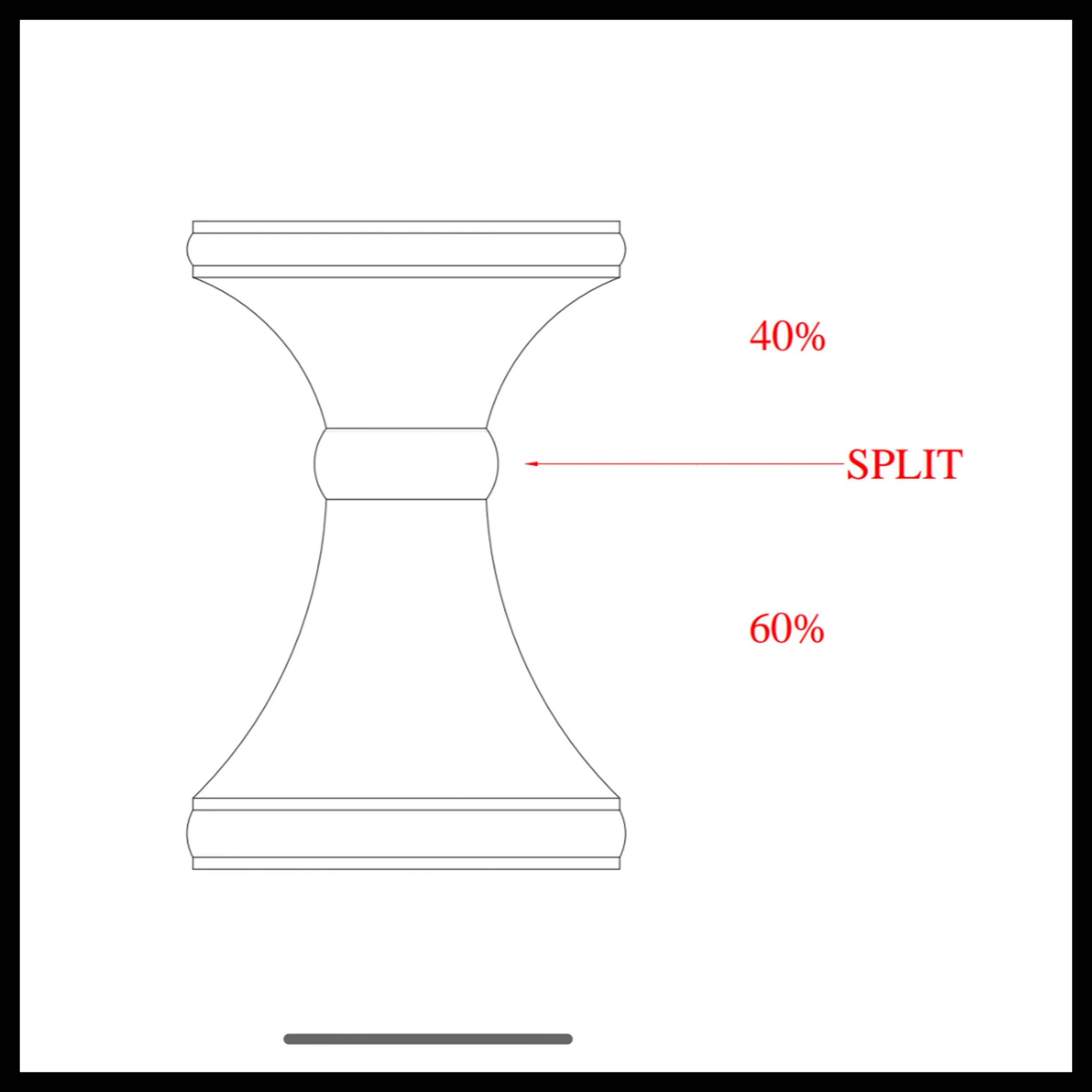
60/40 Pedestal Geometry — The Builder’s Ratio
The 60/40 split is the builder’s version of the Golden Ratio — a simple proportion that maps balance, weight, and silhouette before a single cut is made. This drawing shows the real pedestal built from that ratio, revealing how the upper 40% carries the visual lift while the lower 60% grounds the form. It’s the geometry behind a pedestal that feels stable, intentional, and quietly refined.
The Golden Rule, Simplified for Woodworkers
There’s almost always one answer, and you’ve probably heard the term before. Let’s keep it simple. The first time I heard about the Golden Rule was in photography — splitting an image so the horizon sits around 60% above and 40% below the frame.” It’s not exact, but a photo balanced that way just looks right. There are exceptions, nothing is glued down here. It’s a guideline.
That same idea applies to woodworking design. Balancing a chest of drawers or turning a bowl can be simplified with a 60/40 split. If you want to be precise, the real number is 1:1.618, but we’re woodworkers. On the computer, sure — I’ll punch in the numbers and get perfect proportions. In real life, we need numbers we can read off a tape measure. So 60/40 is close enough, and once you round to the nearest sixteenth, the split gets even simpler.
How 60/40 Applies to Real Builds
Here’s a quick example. Let’s say a drawer front is 10″ high. A 60/40 split puts the pull with 4″ above it and 6″ below. That’s it. Close enough to the Golden Rule that it looks right. Mark the line, drill the holes, done. Same with a table pedestal — work your layout around this rule and the balance becomes natural.
If you look at real architecture, you’ll see the same proportion. The façade of the Parthenon fits almost perfectly inside a Golden Rectangle. Once you know what you’re looking for, you’ll see this ratio everywhere — houses, cars, furniture, even the Great Pyramid of Giza.
Teaching the Rule in Real Life
Now you might be thinking, “Dave, everybody knows this.” Trust me — a lot of folks don’t. I’ve stood in rooms with designers, cabinetmakers, and other trades, and when something looks off in a drawing, I’ll mention the Golden Rule and make a note to adjust the proportions later when I’m doing the shop drawings. People look at me strange. They don’t know what I’m talking about. I’m not bragging — I’m teaching. The rule is simple, easy, and anyone can follow it.
If you remember nothing else, remember this: unequal balance looks right. A simple 60/40 split often fixes a design — in your layouts, your drawings, your bowl turning, all of it. Even my mom’s old 1979 Buick had a 60/40 split front bench seat… I still wonder where GM got those numbers.
In short
The 60/40 split is the simplest proportion in woodworking — a quiet ratio that makes designs feel balanced without needing exact math. Whether you’re shaping a drawer front, turning a bowl, or laying out a pedestal, unequal balance just looks right. Once you learn to see this proportion, your designs start feeling intentional instead of accidental.
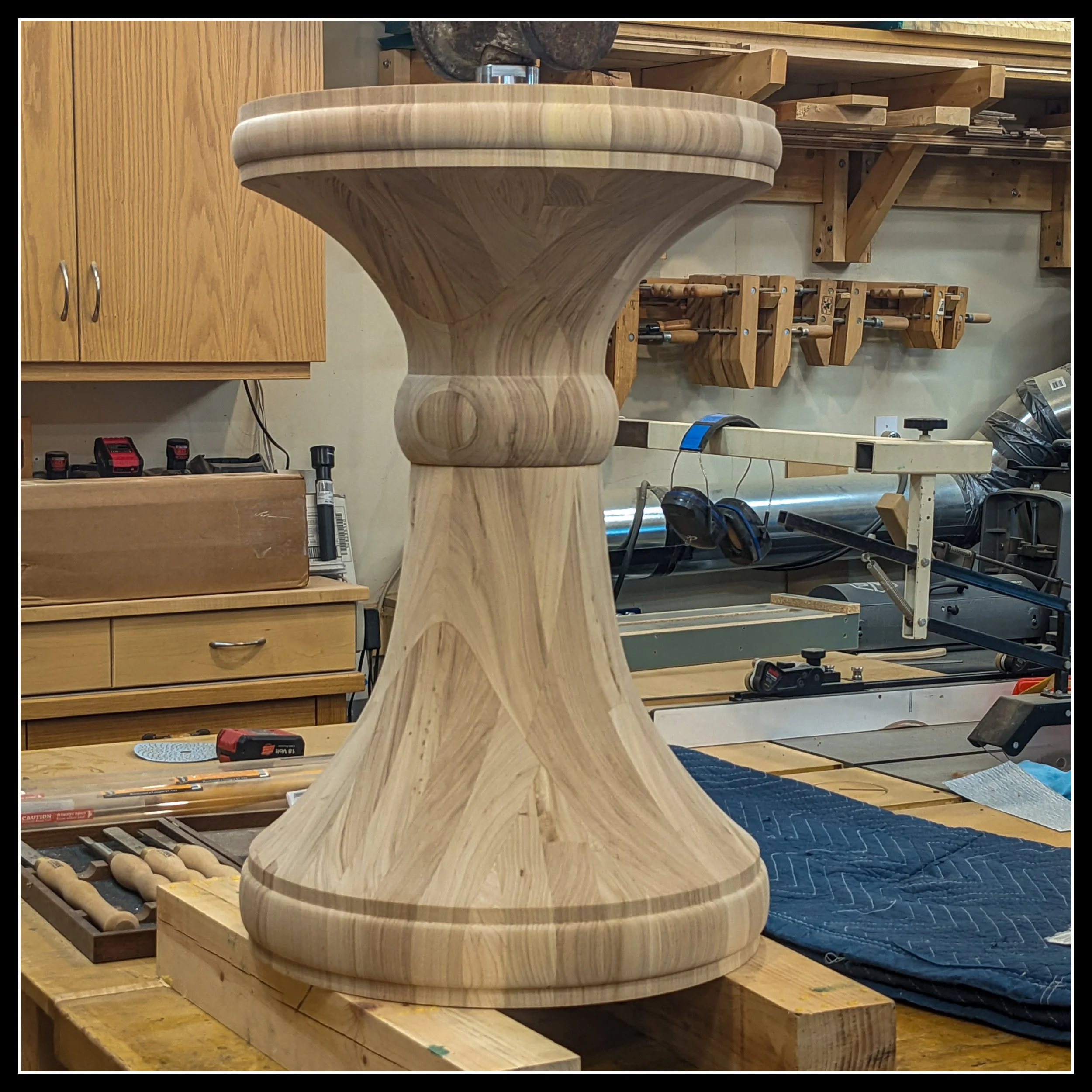
Turned Pedestal with 60/40 Proportion
This pedestal was designed using the same 60/40 proportion described in the story. The hourglass profile carries more visual weight in the lower section, tapering cleanly toward the top so the form feels balanced and intentional. The centre band acts as a visual anchor, giving the piece structure without interrupting the flow of the curves. This is what the 60/40 split looks like in real woodworking — a simple ratio that makes a complex shape feel right.
Digital to Sawdust — Design Studio
Digital tools, layout, and proportion — the design side of woodworking before the sawdust begins.
SHARE
Digital to Sawdust — Design Studio
Lessons in woodworking design, geometry, and digital layout — teaching how furniture is shaped with intention.— head to the Design Studio. Just one click away.
If you’d like to hear from me only when something big is happening — a launch, a milestone, or a major project — you can join the mailing list below.
Written by David Flather, Red Seal cabinetmaker and founder of Knotty Dave’s Fine Woodworking — a Manitoba shop rooted in heritage restoration, storytelling, and real craft.
All photos shot by David Flather — in the shop, on the road, and in the places where craft and story meet.
Related stories:
Design Geometry: Why Thickness Changes Everything in Furniture
Visual Weight in Woodworking: How Proportion Shapes the Feel of Furniture
Photography For Woodworkers: Turning Shop Light Into Real Photography
The Workshop Library
If you enjoyed this story, there’s lots more like it inside The Workshop Library — and it’s free to explore.
Wood Archive — species, grain, working properties, and real‑world craft notes
Behind the Grain — the deeper stories inside wood, craft, and heritage
The Working Side of the Craft — tools, shop life, workflow, and the realities of making
Digital to Sawdust — Design Studio — geometry, proportion, visual flow, and design thinking
The Stories of the Shop — the personal side of craft, the shop’s history, and the quiet moments that shape the work
House & Hearth — heritage home restoration, the hearth room, winter culture, and the lived‑in side of craft
I’m just one man with a shop, building this archive one story at a time. If you’d like to follow the journey as it unfolds, explore The Workshop Library — new stories every week.
