

Douglas Fir
Quick Answer — Why Douglas Fir Matters
Douglas Fir matters because it’s the heritage softwood that shaped a generation of millwork — straight‑grained, warm‑toned, resin‑scented, and strong for its weight. Old‑growth fir built trim, doors, beams, and mid‑century shops, and its bold grain still makes it one of the most expressive softwoods to finish. Fir carries memory, structure, and craft in equal measure — the wood of yesterday that still deserves a place in the shop today.
Straight grain — clean lines, predictable cuts
Warm colour — classic millwork tone
Resinous scent — the smell of mid‑century shops
Strong for its weight — spans distance, holds joinery
Old‑growth heritage — the wood of a generation
Douglas Fir — The Wood of a Generation
Douglas Fir is the only wood that can still take me back to my grandfather’s shop — the smell, the era, the work, the man. Around here, fir belongs to yesterday, but its grain, its strength, and its quiet place in woodworking still run through the pieces that survived him. This story is about that wood, that memory, and the way a single species can carry three generations of craft.
BY THE END OF THIS STORY
You’ll understand why Douglas Fir shaped millwork for decades, how old‑growth fir defined a generation of builders, why the species faded from modern construction, and how its grain and scent still carry the memory of a craft passed down through three generations.
Read time: 6 minutes
Fast Summary
Douglas Fir shaped millwork for decades — straight grain, warm colour, resinous scent, and old‑growth strength. It faded from modern construction, but its character, its memory, and its finishing potential still make it one of the most expressive softwoods in the shop.
Comparison — Douglas Fir vs Pine vs Spruce vs Cedar
Pine — Softer, More Movement
More knots
More resin
More cupping
Douglas Fir — Strong, Warm, Straight
Bold grain
Warm tone
Strong for its weight
Excellent for finishing
Cedar — Softer, More Aromatic
Rot‑resistant
Outdoor‑ready
Not as strong
Spruce — Lighter, More Structural
Straight grain
Less aromatic
More framing‑focused
Bottom Line
Fir is the heritage wood — strong, warm, and expressive.
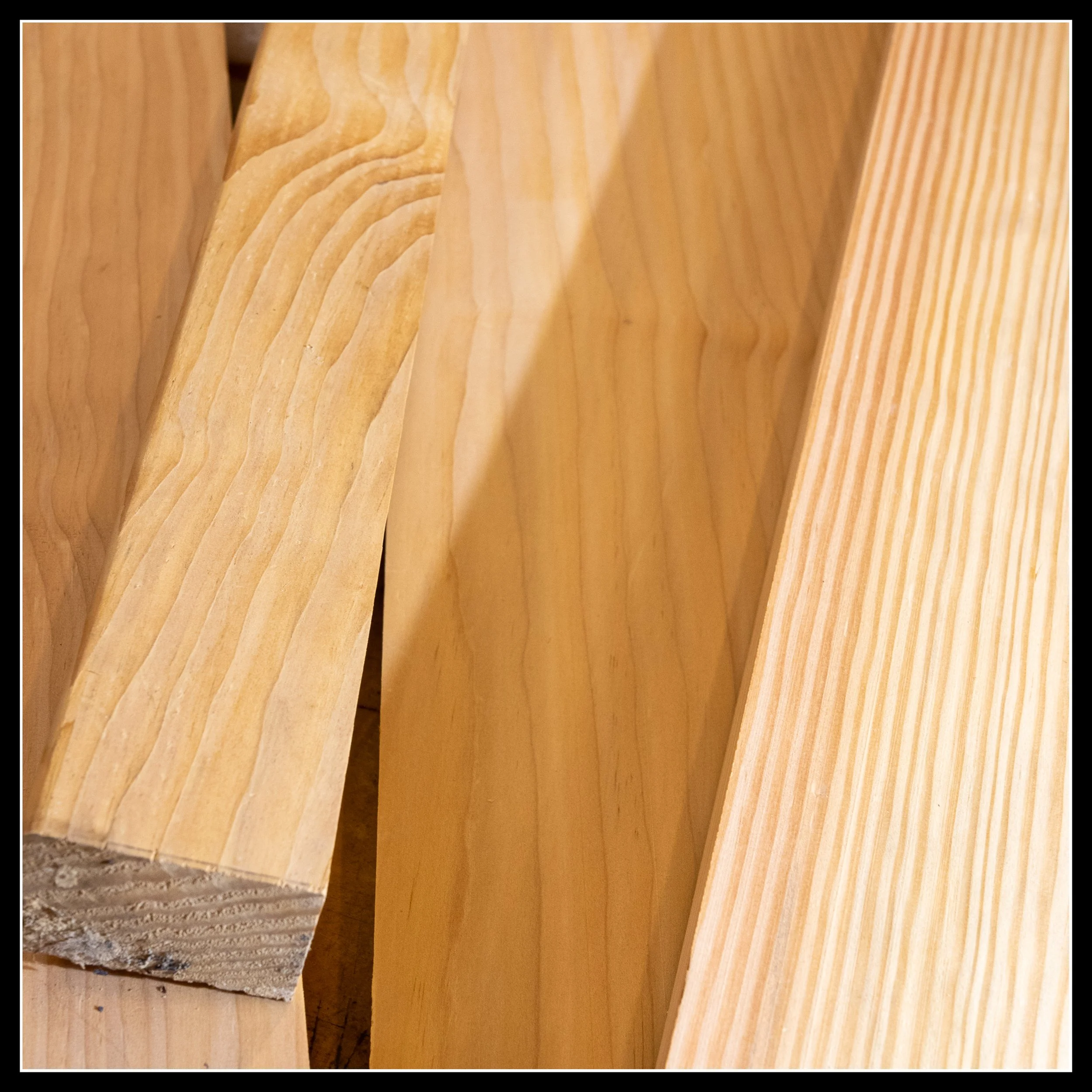
Raw Douglas Fir Boards — Straight Grain, Warm Tone, Classic Fir Character
These are raw Douglas Fir boards — the same species my grandfather used for nearly everything in his shop. Fir has a straight, steady grain, warm colour, and that resinous scent that defined his era. People search for wood grain images all the time, and this is what real fir looks like: clean lines between the growth rings, a natural brightness that deepens with age, and a character that made it the backbone of Prairie trim, millwork, and mid‑century shop builds. This is the wood Grandpa reached for every day.
The Smell of Fir — A Cabinetmaker’s Memory
When somebody walks into my shop, they always comment on the smell of wood and how lovely it is. Most days I can’t smell it anymore. I’ve gone nose‑blind to it, unless I’m cutting into a species I haven’t touched in a while. Then, for a moment, it hits me again — that fresh, clean, resinous scent — and I remember why I love this work. But soon enough, even that fades into the background.
It was the same when I was a kid.
My grandfather was a cabinetmaker, and when we visited him, his shop had a smell I still carry with me. It wasn’t the smell of my shop. It was the smell of his era — the world of yesterday, built from the woods he reached for every day. He retired in the 1970’s but kept building until he couldn’t anymore. That’s when I knew him: seasoned, settled, and steady, like the wood he worked with for decades.
And of all the woods he used, one thing is obvious now when I look at the pieces that survived:
Grandpa liked Douglas Fir.
He milled it, joined with it, finished it, and even the plywood he used was fir. That smell — that warm, resinous, slightly citrus fir smell — that’s my grandfather’s shop. That’s the scent that still stops me in my tracks when I cut into fir today.
Fir is a wood I’ve always found good‑looking. That’s subjective, I know, but fir has a bold grain between the growth rings, a straightness that doesn’t twist and cup like pine, fewer knots than spruce, harder than cedar, and enough strength to span a distance. It’s harder than most softwoods and holds an edge like a hardwood. It’s a nice wood. That’s why Grandpa liked it. I would have bought it too.
Fir — Trim, Doors, and Millwork
My old house — like many old houses with original trim — had fir trim, fir doors, fir framing. But time and trends move on. Hardwood floors were popular until they weren’t. In the 1970’s, hardwood/softwood flooring fell out of style and got buried under wall‑to‑wall carpet. Wood floors were considered old and cold. And with that shift, fir trim and doors were smothered in paint and hidden from sight.
Once the design world decided everything would be painted, builders switched to cheaper woods. Carpet went straight onto the subfloor. Poplar and pine took over trim. MDF arrived and finished the job. Spruce took over framing. And fir — once the backbone of Prairie trim and millwork — suffered cultural erasure.
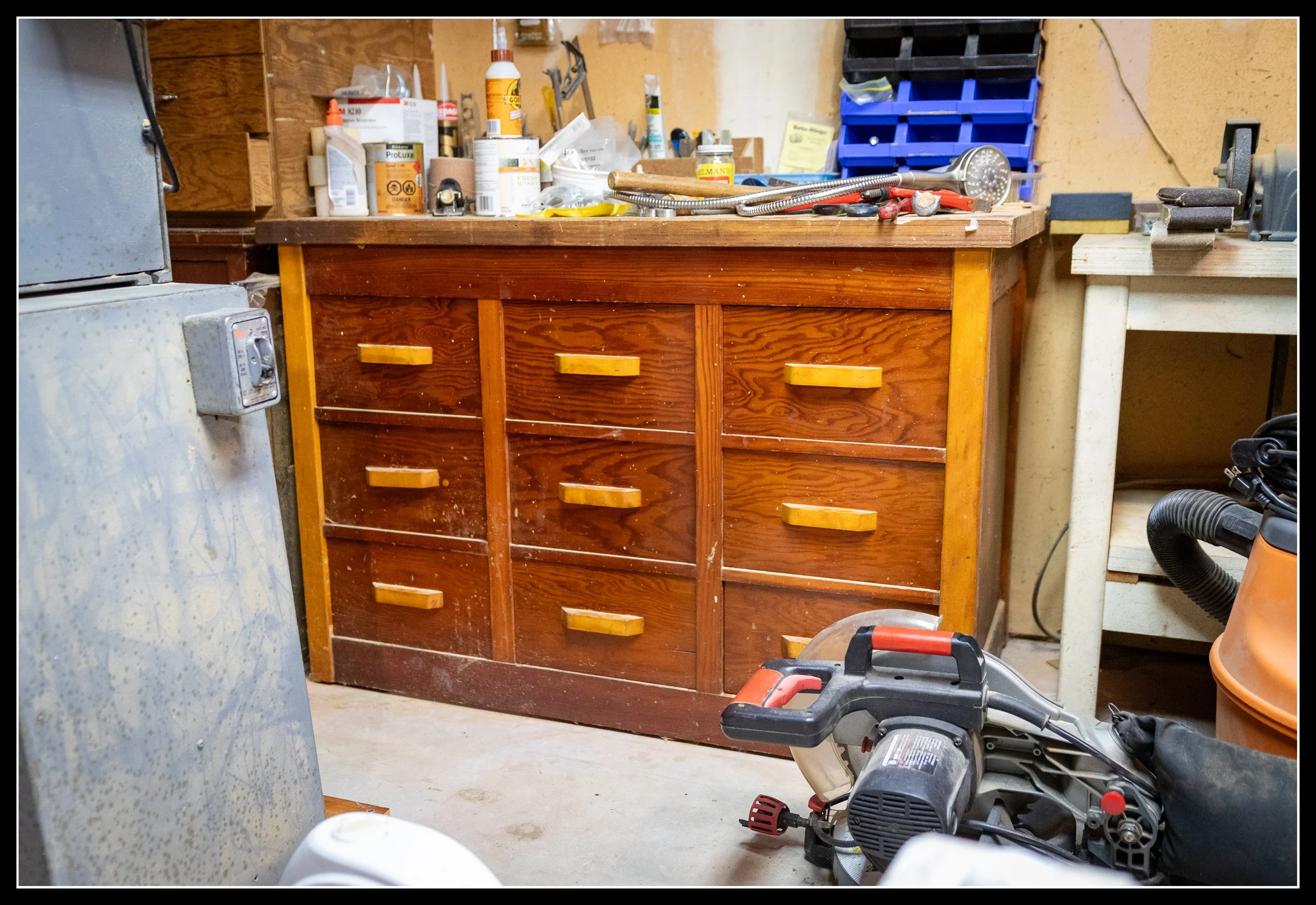
Douglas Fir Shop Chest — 1940’s Grandfather‑Built Workshop Storage
This chest of drawers comes from my grandfather’s workshop — a piece that could easily date back to the 1940’s. It’s built from solid Douglas Fir and matching fir plywood, finished in the clear coat he used on everything. The colour has deepened with time, and the drawers still carry the smell of his shop, the same warm, resinous fir scent I remember from childhood. Grandpa used this chest every day, and now it sits in my dad’s basement, still holding tools, still holding history, still carrying the era it came from.
Old‑Growth Fir — The Giants That Built the West
There was a time when Douglas Fir arrived on the Prairies in long, straight beams — old‑growth giants shipped in by rail, cut from trees that had stood for centuries. Places like MacMillan Provincial Park show what those forests really looked like: towering, untouched stands of ancient fir, the kind of trees that once fed Western Canadian construction. Reminders of the scale that once fed Western Canadian construction. As those stands dwindled, the industry shifted to second‑pick logs, then to second‑growth timber: younger, shorter, smaller trees that simply couldn’t produce the same spans or the same character. Today the old‑growth giants are protected, and the era of massive fir beams is over. The wood my grandfather worked with belonged to a different time, a different forest, and a different scale of tree.
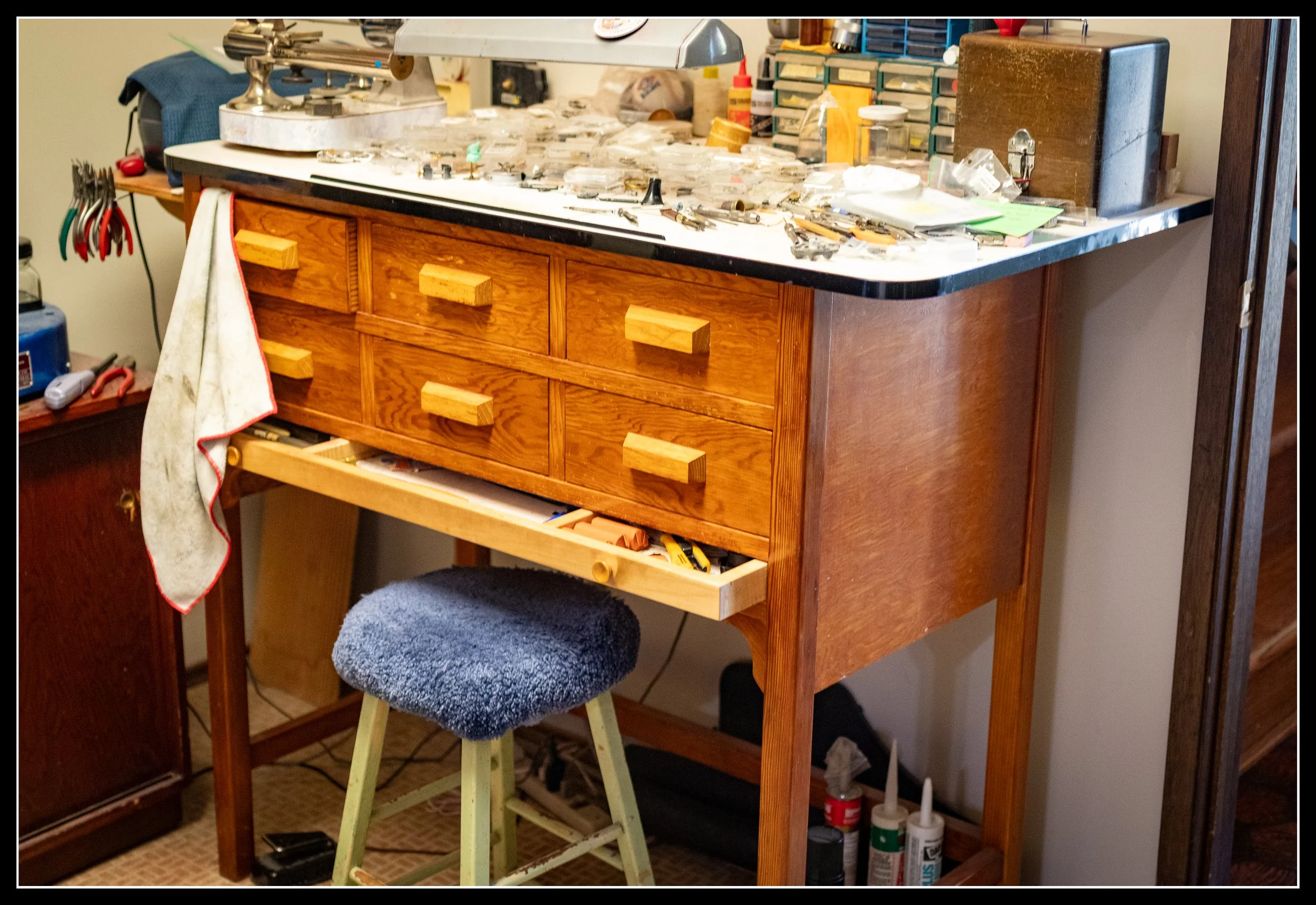
Grandfather‑Built Douglas Fir Watchmaker’s Bench — Late 1950’s Craftsmanship
This watchmaker’s bench was built for my dad by my grandfather, likely in the late 1950’s — classic Douglas Fir construction, both plywood and solid fir framing, finished in the clear coat of its era. The top is plastic laminate, and the wide bottom drawer was replaced somewhere along the way with a poplar one, but the soul of the piece is untouched. It’s the kind of build Grandpa made without fuss: steady, practical, and meant to last. The fir has aged into a colour only time can deepen, carrying the same warm, resinous tone that defined his shop and the era he worked in.
Fir Today — A Specialty Wood Remembered More Than Used
Douglas fir is still widely used across North America, but here on the Prairies it faded out of everyday building and became a specialty wood — remembered more than it’s used.
Lumberyards stopped stocking it.
Designers stopped specifying it.
Clients stopped asking for it.
And people forgot what it was.
Today, fir is the same wood it always was — strong, warm, straight, and beautiful — but now it’s a specialty wood priced like a hardwood. Maple and oak compete with it for the same dollars, so fir isn’t gaining any followers. Not here in Prairie country.
I still see new homeowners tearing out original Douglas Fir trim with excitement, replacing it with MDF because that’s what the market taught them to do. Fir is the wood from yesterday, and that’s too bad. It deserves better. It deserves a comeback.
Fir in the Shop
Whatever happens, I’m rooting for it.
And that smell — I’m telling you — the rare time I’m cutting fir in my shop, that smell brings Grandpa right back beside me. For a moment, my shop smells like his little old shop, and I’m a kid again. Maybe Douglas Fir won’t make a comeback here, but as long as that smell can find me, it’ll never be gone.
Deep Scraped Douglas Fir — Grain, Memory, and Modern Finish
Douglas Fir isn’t just a heritage wood — it’s a finishing powerhouse. These two samples from my deep scraped collection show how far fir can be pushed when the grain, the texture, and the technique all line up.
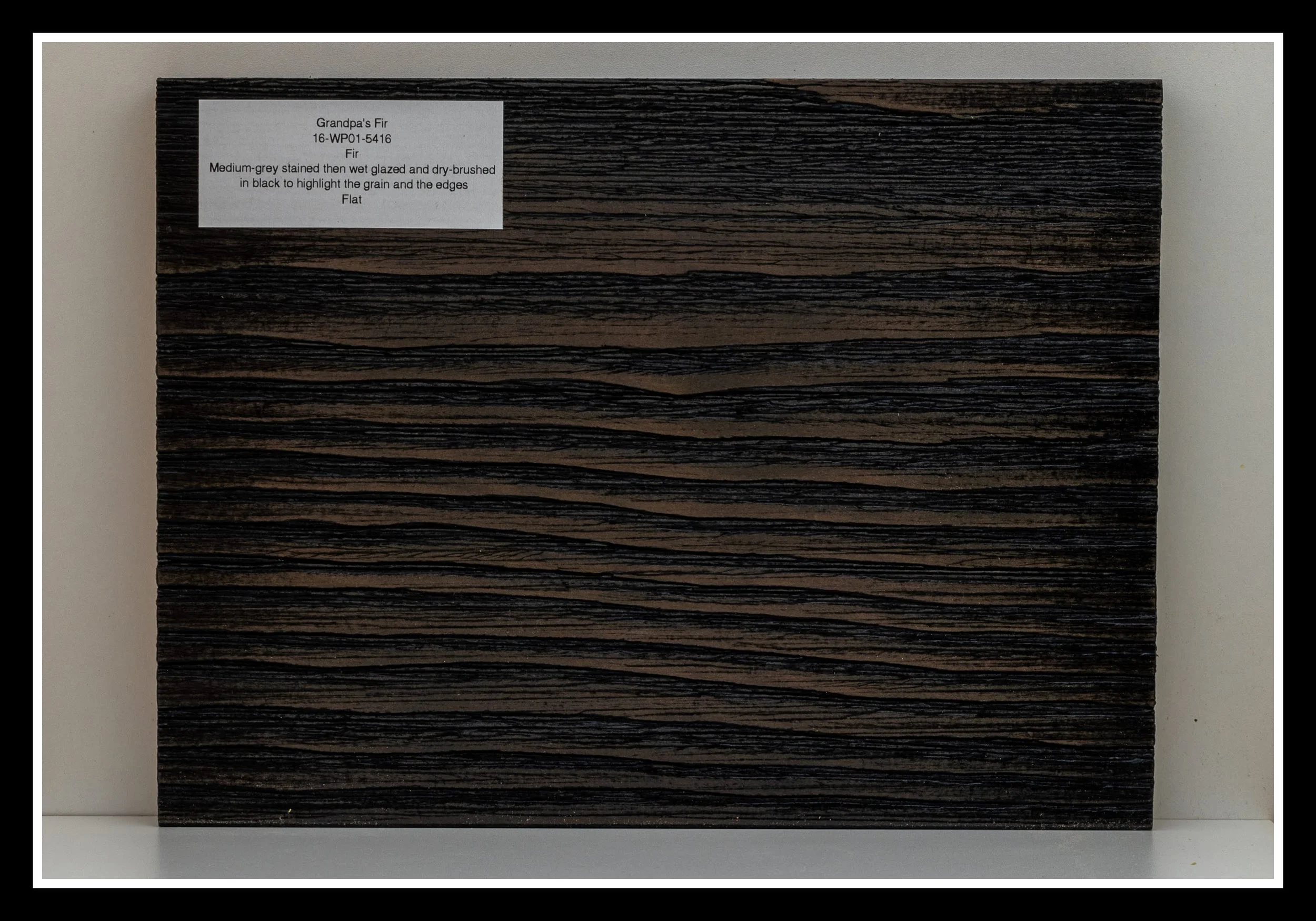
Douglas Fir Finish Sample — “Grandpa’s Fir” Wet‑Glazed & Dry‑Brushed Grain
This finish sample comes from my deep scraped collection, showing exactly why Douglas Fir is one of the best woods for textured and brushed finishes. Fir has the right kind of grain burst — bold enough to catch stain, but not too busy to distract — and it responds better than any other species I’ve worked with. This sample is called “Grandpa’s Fir,” named for the man who built half his shop out of this wood. Medium grey stain, wet glazing, and dry brushing in black bring out the grain in a way only fir can. It’s a modern finish on a wood from yesterday, and it carries the same character my grandfather worked with every day.
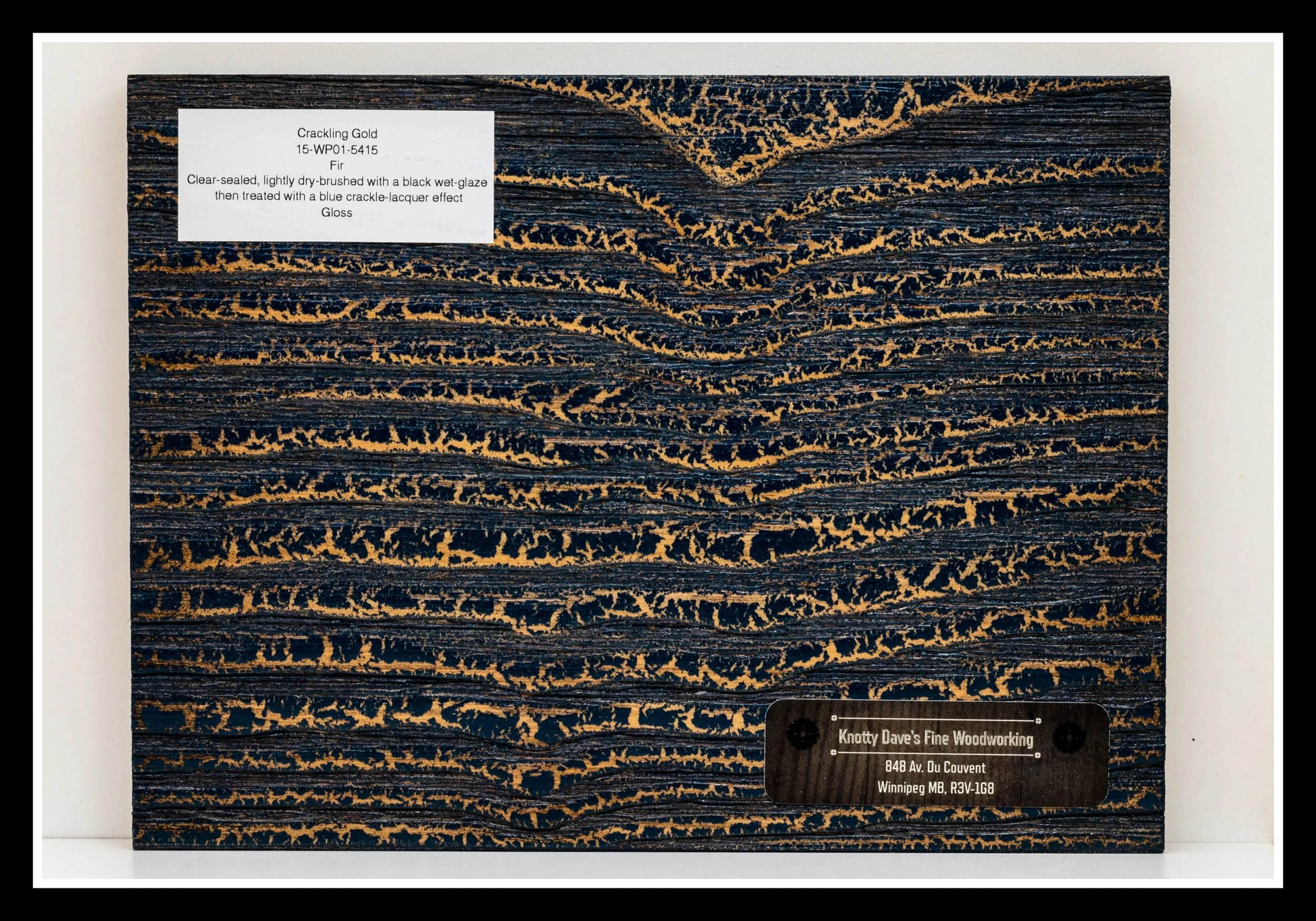
Douglas Fir Finish Sample — “Crackling Gold” Multi‑Layer Glaze & Crackle Lacquer
This is “Crackling Gold,” another piece from my deep scraped collection — finishing taken to the extreme. Multiple layers of stain, glaze, and a gold crackle coat, dry‑brushed and sealed under 2K poly, all on brushed and textured Douglas Fir. Fir handles this kind of finish better than any other wood I’ve worked with: bold grain, steady texture, and just enough structure to hold every layer without getting muddy. This sample shows what fir can do when pushed — heritage wood carrying a modern, high‑impact finish.
Where every species, every board, and every lesson in wood science comes together — a place to explore the materials that shape our craft.
SHARE
The Wood Archive — All the wood Stories in One Place
For the living side of woodworking — the stories shaped by walnut, oak, maple, cherry, elm, cedar, and poplar — head to the Wood Archive.
If you’d like to hear from me only when something big is happening — a launch, a milestone, or a major project — you can join the mailing list below.
Written by David Flather, Red Seal cabinetmaker and founder of Knotty Dave’s Fine Woodworking — a Manitoba shop rooted in heritage restoration, storytelling, and real craft.
All photos shot by David Flather — in the shop, on the road, and in the places where craft and story meet.
Related Stories:
The Value of Wood in the Fur Trade: Winter Logging, River Transport, and York Boat Timber
The Elm Trees of North America: Canopy, Loss, and the Craft That Remains
Outdoor Wood: Rot Resistance, Freeze‑Thaw Survival, and 200 Years of Real‑World Weather
The Mistake Every New Woodworker Makes: Understanding Wood Movement Before It Ruins Your Project
The Workshop Library
If you enjoyed this story, there’s lots more like it inside The Workshop Library — and it’s free to explore.
Wood Archive — species, grain, working properties, and real‑world craft notes
Behind the Grain — the deeper stories inside wood, craft, and heritage
The Working Side of the Craft — tools, shop life, workflow, and the realities of making
Digital to Sawdust — Design Studio — geometry, proportion, visual flow, and design thinking
The Stories of the Shop — the personal side of craft, the shop’s history, and the quiet moments that shape the work
House & Hearth — heritage home restoration, the hearth room, winter culture, and the lived‑in side of craft
I’m just one man with a shop, building this archive one story at a time. If you’d like to follow the journey as it unfolds, explore The Workshop Library — new stories every week.
