

The Mistake Every New Woodworker Makes (And I Made It Too)
Quick Answer — Why Beginners Struggle With Wood Movement
Beginners struggle because they try to force wood to behave. Softwoods like spruce twist, cup, and dry unevenly indoors, grain reverses without warning, and moisture shifts fight every cut. Wood movement is the first real obstacle new woodworkers face — and it’s the one mistake everyone makes before they learn to work with how the tree grew.
Wood moves — it swells, shrinks, twists, and cups as moisture changes
Spruce behaves differently — framing lumber is unstable indoors
Grain direction matters — reversing grain causes tear‑out and frustration
Construction lumber isn’t furniture lumber — it dries unevenly and warps
You can’t force wood — you must work with how the tree grew
Working With Wood Movement
Most new woodworkers make the same mistake — and it has nothing to do with tools, skill, or buying the wrong species. It’s simpler, more universal, and it hits every beginner the same way. They try to force the wood to behave. That’s the mistake I made too. And I made it the hard way.
BY THE END OF THIS STORY
You’ll understand why wood refuses to obey, how grain direction and moisture create movement, why spruce behaves differently from hardwoods, and how respecting the way wood grew prevents the frustration every new woodworker faces.
Read time: 5 minutes
Fast Summary
Wood moves — always. Softwoods like spruce twist, cup, and dry unevenly indoors, while hardwoods move more slowly and predictably. Grain direction reverses, moisture shifts, and construction lumber behaves nothing like furniture wood. Once you understand how the tree grew — and work with that movement instead of fighting it — clean joinery, flat glue‑ups, and stable builds finally become possible.
Comparison — Hardwood vs Softwood for Beginners
Softwood — Fast Growth, Dramatic Movement
Softwoods grow fast, building wide grain and lighter structure. That fast growth makes their movement more dramatic, especially indoors.
Wide grain — reversing grain causes tear‑out and frustration
Lower density — twists, cups, and bows more easily
Unstable indoors — framing lumber dries unevenly
Moisture swings — reacts quickly to humidity changes
Softwoods teach beginners how much wood can move — often painfully.
Hardwood — Slow Growth, Predictable Movement
Hardwoods grow slowly, building tight grain and dense structure. That slow growth makes their movement more predictable indoors.
Tight grain — less dramatic swelling and shrinking
Higher density — resists twist and cup
Stable indoors — ideal for furniture and benches
Consistent moisture behavior — easier to flatten, joint, and glue
Hardwoods still move — all wood moves — but they move in a way beginners can learn to predict.
Bottom Line — Movement Is the Real Difference
Hardwoods move slowly and predictably. Softwoods move quickly and dramatically.
Beginners struggle because they start with softwoods, which exaggerate every mistake. Hardwoods behave better — but only if you respect how the tree grew.
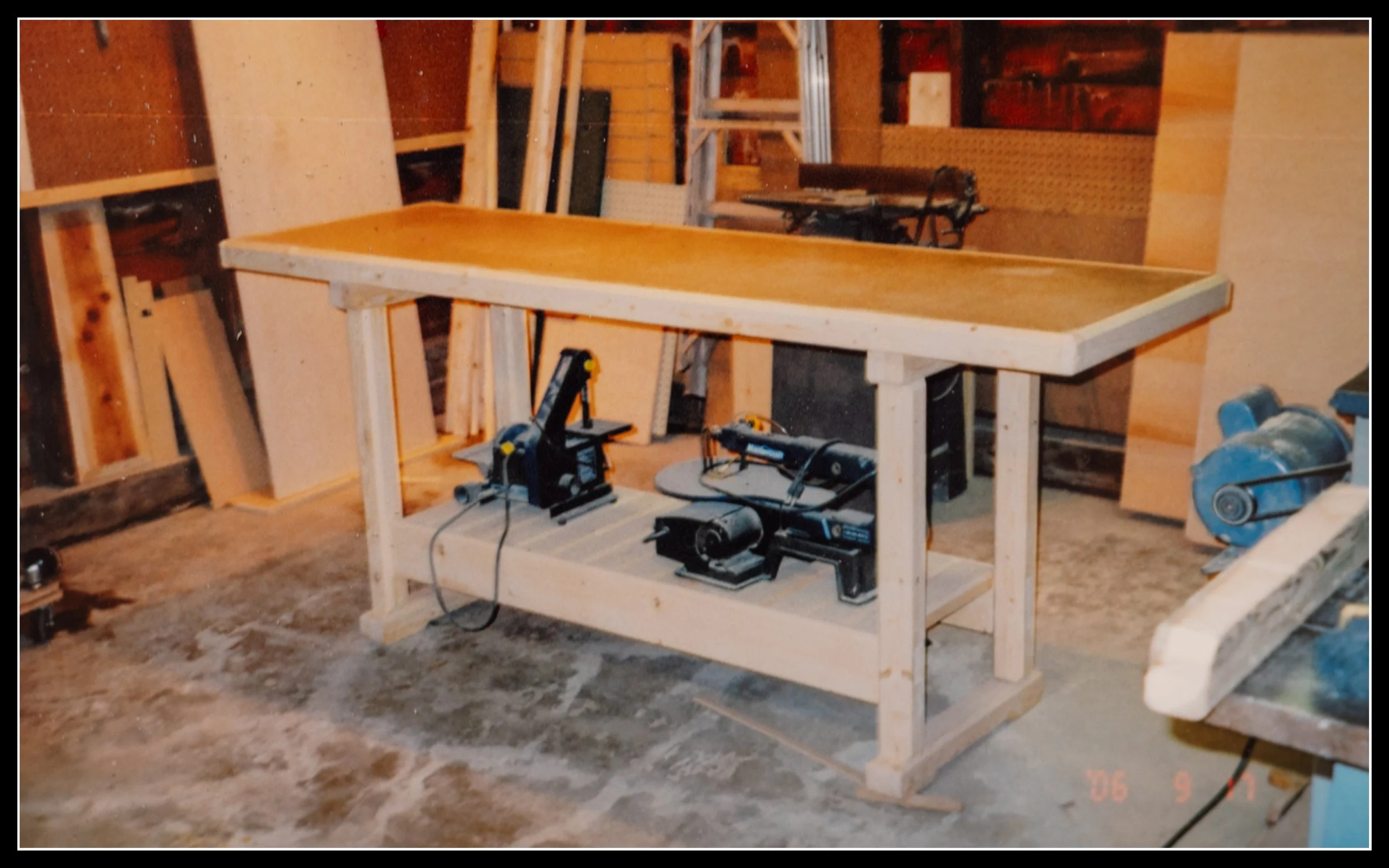
The Bench Before I Knew Better
This was the bench in my first shop — a spruce top I glued into a slab and tried to believe was straight. The truth showed itself the moment the clamps came off. The twist was already locked in, permanent, baked into the boards. I added a sheet of ¼‑inch MDF over the top to hide it, hoping it would feel solid enough to work on. In photos it looks fine, almost proud, but every woodworker knows that look: good from far, far from good. This was the project that taught me you can’t force wood into behaving. It behaves how it grew.
Back When I Thought Wood Would Obey
This was back when the spark to create was new and bright — when I’d rush into the shop after work, long before YouTube existed. Back when the best woodworking advice came from library books and magazines.
I decided I wanted a real workbench. A solid wood top, just like the ones in the books. Maple was out of my budget, and honestly, it intimidated me. So I went to the lumber yard and bought the straightest Canadian‑grown spruce 2x4s I could find.
Even then, hauling a fresh pile of lumber into the shop felt electric. It still does.
The “Genius” Plan That Wasn’t
I didn’t own a jointer or a planer. My thinking was simple: the mill machined the boards, so they must be good enough. The plan was to glue them face to face into a 3½‑inch slab. Easy. Perfect. Foolproof.
I laid them out on the crooked, broken foundation of my old shop floor.
And I only had a few short clamps.
But I had 2½‑inch screws, so that became my “clamping system.”
Glue a face. Lay a board. Drive a screw. Repeat.
Four 2x4s in, the glue was dripping, the boards were hydroplaning, the gaps weren’t closing, and frustration was rising. But I kept going — driving more screws, wiping excess glue, driving a few more screws. By the end, I had a 24‑inch‑wide slab and I was fresh out of screws. I cleaned the last of the squeeze‑out and convinced myself it wasn’t that bad.
The Twist That Broke My Heart
The next morning, reality hit. I stood the slab on its side and saw the twist — a full‑body, stomach‑dropping twist. My heart sank. And those gaps seemed wider than I remembered.
I threw it on sawhorses and grabbed my Grandpa’s old hand plane. That’s when I learned about knots, reversing grain, and the kind of sweat that comes from fighting a losing battle. And spruce has knots and pitch pockets full of sap. I made a lot of wispy curls of spruce, but with ¾‑inch of twist, I was learning how little material a hand plane actually removes.
But I told myself the base would fix it. Heavy legs, through mortises, 2x6 bracing — the works. Once the top was screwed down, it would straighten.
It didn’t.
The frame twisted to match the top.
I’ll say this: my determination was legendary. I shimmed between the base and the top so it wouldn’t rock. I used that hand plane and planed until I couldn’t anymore. Eventually I screwed a sheet of ¼‑inch MDF to the top and called it done.
As the bench sat in the shop over the next six months, the twist kept getting worse. Those boards were drying, some were twisting, some were cupping, and all of them were shrinking. Wood moves — and spruce is not meant as an interior wood. It’s a framing wood. I’d try planing it when I felt like a workout, but the wood refused to do what I wanted.
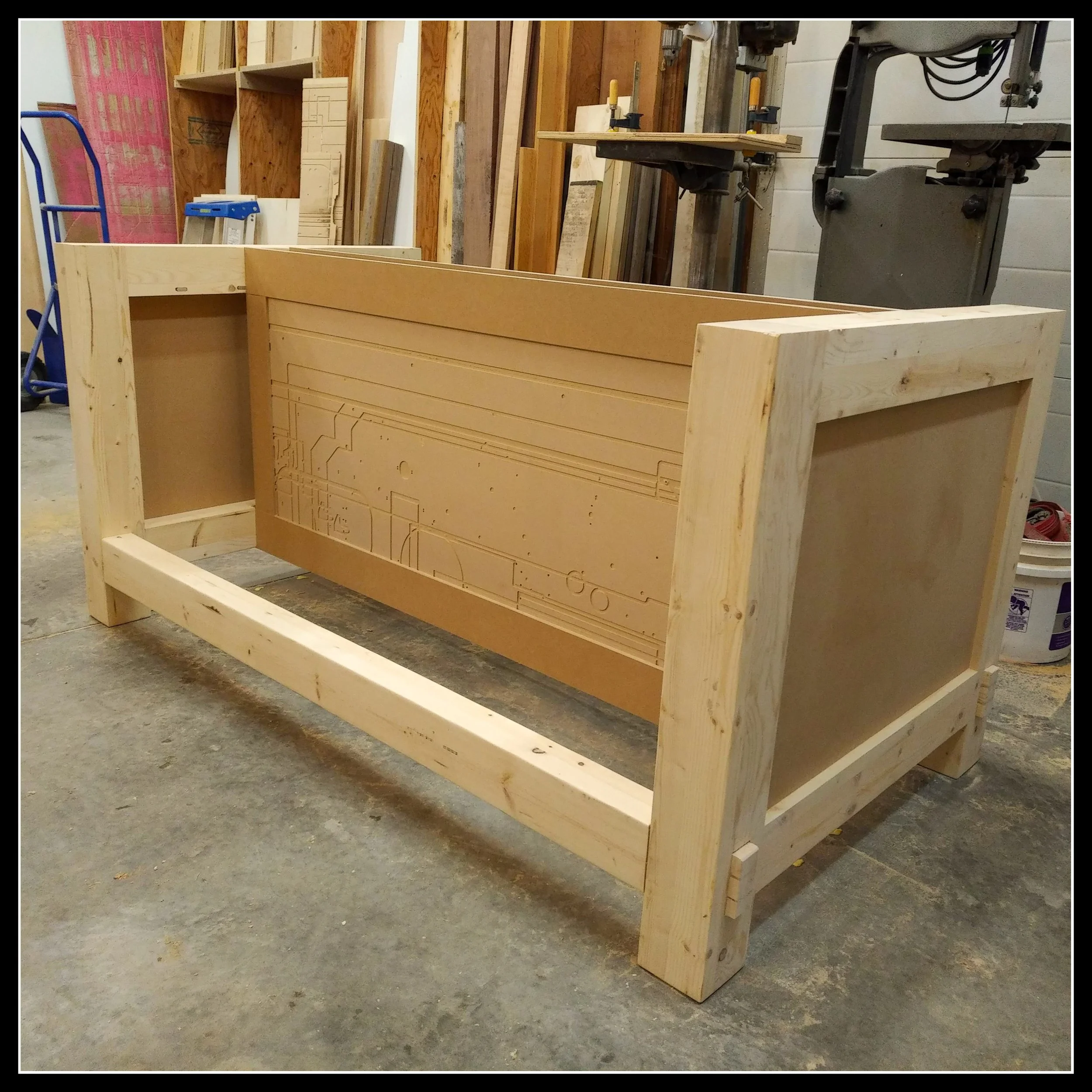
The Bench Built After the Lesson
This is the MFT bench in my shop today, photographed during construction years after the spruce disaster. Straight, square, and so heavy I could park a truck on it, this bench is everything the first one wasn’t. It’s built from patience instead of frustration, from understanding instead of force. The top is flat, the frame is true, and the whole thing feels like it will outlive me. Every woodworker eventually builds a bench like this — the one that comes after the lesson.
The Lesson That Changed Everything
That bench is still with me. It sits in my tool shed now, with a chainsaw leaking bar oil on it and whatever else gets tossed on top. But that bench taught me the truth:
Wood is wood — spruce, Hickory, walnut — it all twists, swells, shrinks, and carries knots and reversing grain. You can’t force it. You have to understand it. You have to respect how it grew and how it wants to behave.
Books taught me a lot.
Magazines taught me more.
But messing things up? That was priceless.
The real lesson?
I should have used plywood.
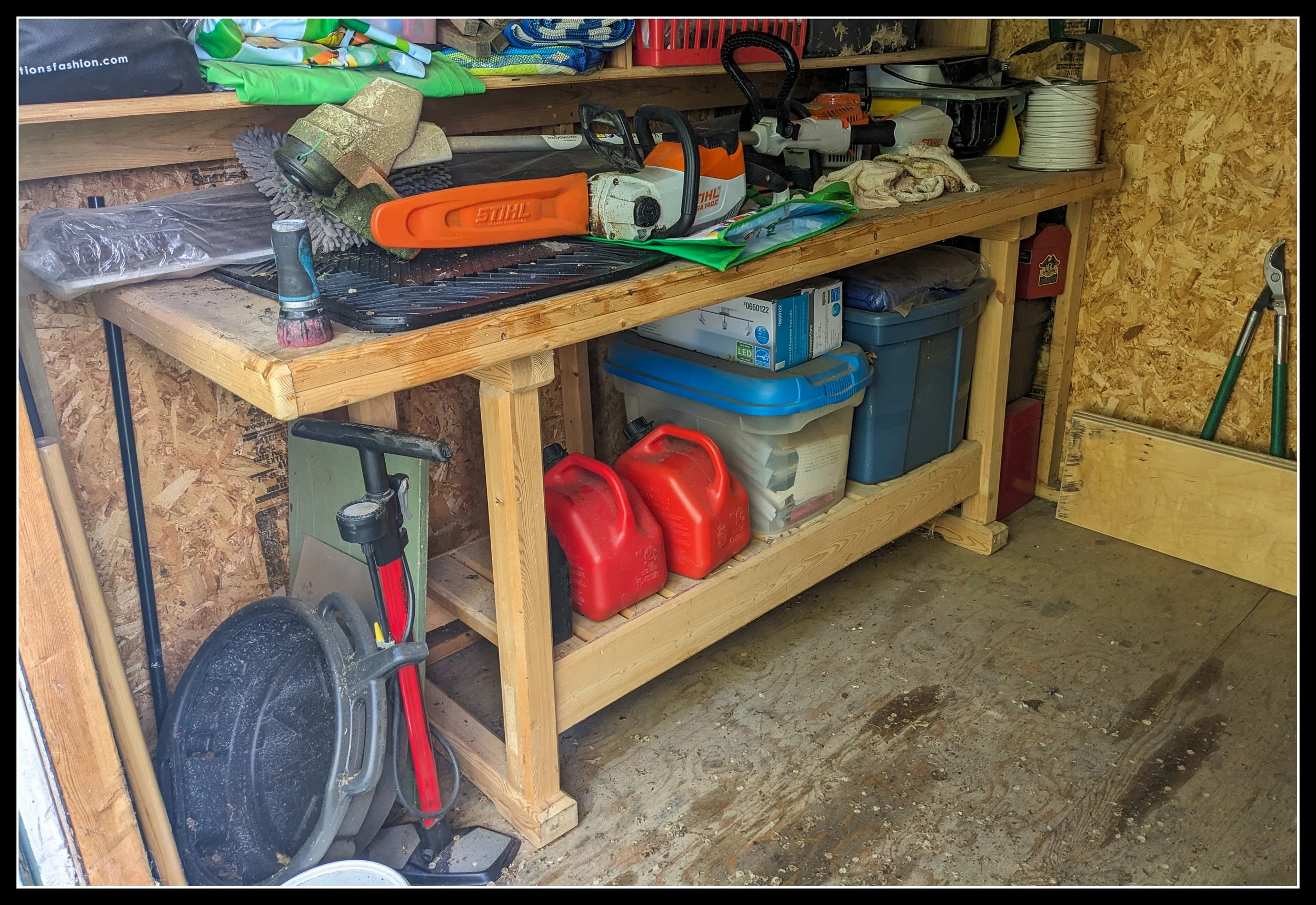
The Spruce Bench That Taught Me
This old spruce workbench in my shed is the one from the story — the slab I fought, the twist I tried to plane out, the mistake that taught me more than any book ever did. It’s stained with bar oil now, buried under tools and fuel cans, but every mark in that top is a record of who I was when I thought wood would obey if I pushed hard enough. Standing in front of it today, I’m reminded that every woodworker carries a project like this: something stubborn, something humbling, something that teaches you to respect the grain instead of trying to conquer it.
Where every species, every board, and every lesson in wood science comes together — a place to explore the materials that shape our craft.
SHARE
The Wood Archive — All the wood Stories in One Place
For the living side of woodworking — the stories shaped by walnut, oak, maple, cherry, elm, cedar, and poplar — head to the Wood Archive.
If you’d like to hear from me only when something big is happening — a launch, a milestone, or a major project — you can join the mailing list below.
Written by David Flather, Red Seal cabinetmaker and founder of Knotty Dave’s Fine Woodworking — a Manitoba shop rooted in heritage restoration, storytelling, and real craft.
All photos shot by David Flather — in the shop, on the road, and in the places where craft and story meet.
Related Stories:
The Value of Wood in the Fur Trade: Winter Logging, River Transport, and York Boat Timber
Rarity of Wood: Why Old‑Growth Lumber Is Disappearing — And Why It Matters
Understanding Wood: Why Trees Grow the Way They Do — And How That Shapes Every Board
Old Cedar — Reclaimed Deck Boards, Cedar Grain, and Building Muskoka Chairs
The Workshop Library
If you enjoyed this story, there’s lots more like it inside The Workshop Library — and it’s free to explore.
Wood Archive — species, grain, working properties, and real‑world craft notes
Behind the Grain — the deeper stories inside wood, craft, and heritage
The Working Side of the Craft — tools, shop life, workflow, and the realities of making
Digital to Sawdust — Design Studio — geometry, proportion, visual flow, and design thinking
The Stories of the Shop — the personal side of craft, the shop’s history, and the quiet moments that shape the work
House & Hearth — heritage home restoration, the hearth room, winter culture, and the lived‑in side of craft
I’m just one man with a shop, building this archive one story at a time. If you’d like to follow the journey as it unfolds, explore The Workshop Library — new stories every week.
