

Track Saws: The Small‑Shop Tool That Replaces a Panel Saw
Quick Answer — Why Track Saws Matter in Small Shops
A track saw delivers CNC‑level accuracy and clean, chip‑free cuts without needing CNC space. It solves the biggest problem in small professional shops: cutting large panels square, safely, and repeatably. With an MFT bench, a track saw becomes a geometry tool — accurate, portable, and capable of jobsite‑ready precision that cabinet saws and circular saws can’t match.
Core Takeaways
Track saws cut large panels square — even 40" × 112" sheets
Scoring cuts eliminate chip‑out — veneer‑safe workflow
Accuracy comes from the MFT bench — dogs + rail registration
Portability brings shop accuracy onsite
Dealer support matters more than brand
Dust collection is essential in small shops
Speed is the trade‑off — accuracy is billable
Track Saw Accuracy, Portability, and Workflow
A track saw is the small‑shop solution to cutting large panels square, clean, and repeatably without needing a panel saw or CNC. This story explains how track saws deliver professional accuracy, why portability matters, how the MFT bench creates geometry you can trust, and the workflow trade‑offs that make track saws indispensable in tight spaces.
BY THE END OF THIS STORY
You’ll understand why track saws can outperform cabinet saws on large panels, how scoring cuts eliminate chip‑out, why the MFT bench is the accuracy engine behind the system, and how portability, dust collection, and dealer support make track saws indispensable in small professional shops.
Estimated read time: 10 minutes
Fast Summary — Track Saws in Small Shops
Track saws solve the biggest problem in small professional shops: cutting large panels square, clean, and repeatably without needing a panel saw or CNC. The track provides geometry, the MFT bench locks in accuracy, and scoring cuts eliminate chip‑out. Portability brings shop‑level precision to the jobsite, dust collection keeps the air clean, and dealer support ensures the system stays reliable for years. Track saws are slower than big machines, but the accuracy is billable — and in tight spaces, they’re the most efficient way to work.
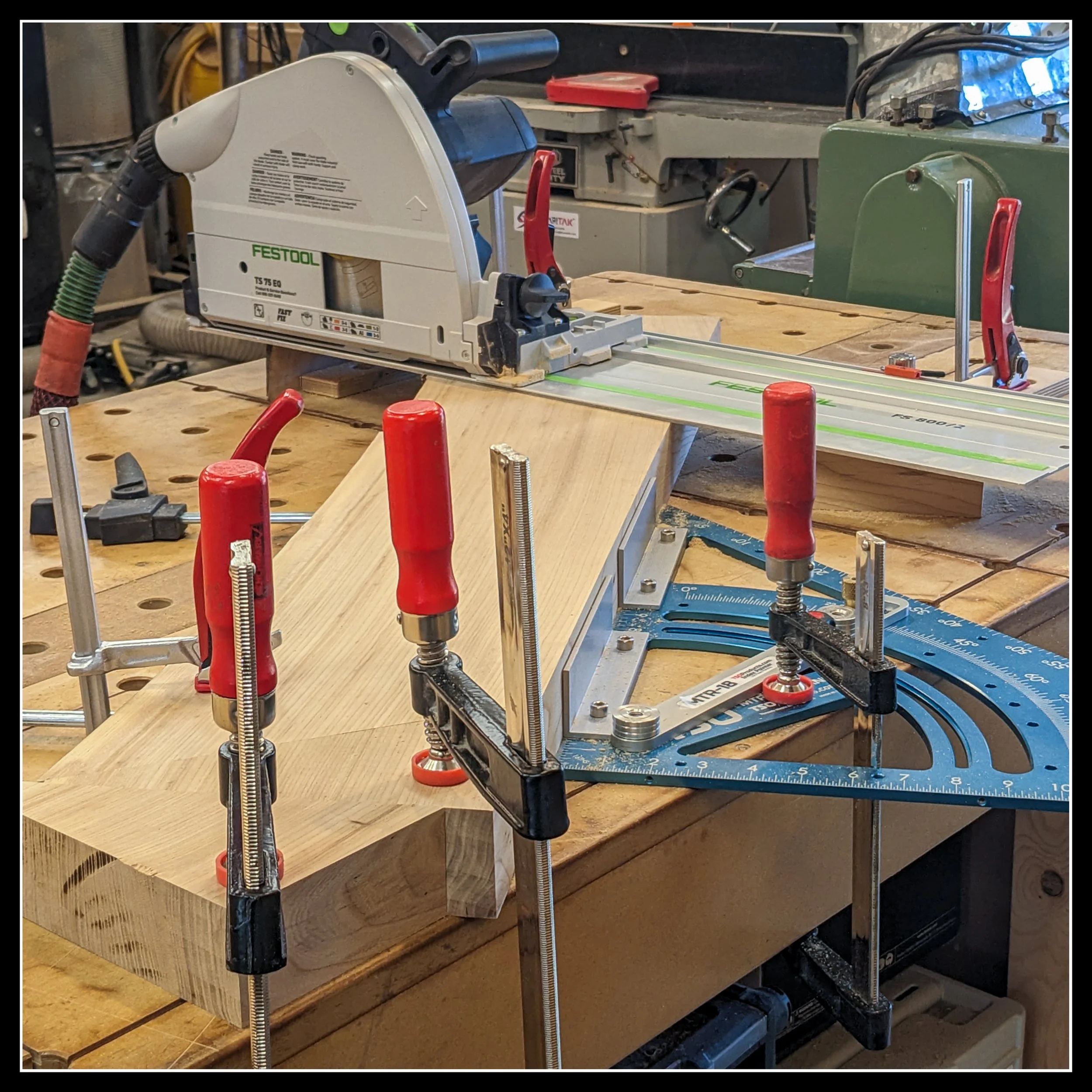
Cutting Angles in Solid Elm — Track Saw + TSO Geometry
This setup is where angle work becomes predictable. Solid elm, clamped tight against the TSO guides, with the track locked onto the MFT dogs. The rail isn’t just a straightedge here — it’s a geometry tool. The jig fixes the angle, the bench locks the position, and the track saw delivers a clean, controlled cut that stays true from end to end. Elm can fight you, but with the right registration points, it behaves. This is small‑shop accuracy at full strength.
Why Track Saws Matter in a Small Shop
I work in a small shop — 550 square feet. Big by some people’s standards, but in a professional cabinet shop it gets small real fast when the day is moving. I’d love to have a panel saw, or even a compact one, but the shop simply works best with my old cabinet saw. The problem is simple: cabinet saws aren’t designed to cut large panels square, and that problem needs a real solution.
A cross‑cut sled sounds like an answer, but the cabinets I build are far too big for any sled. My radial arm saw is actually quite accurate, but it’s limited to a 17‑inch cut. A CNC would solve everything — perfect geometry, repeatability, no chip‑out — but I can’t justify the floor space. In a small shop, every square foot has a job, and a CNC takes more than it gives.
So I needed a way to make square or angled cuts with a high degree of accuracy, and I needed those cuts without chip‑out. That’s where the track saw comes in. It’s accurate, portable, and capable of delivering CNC‑like precision without requiring CNC‑like space. Accuracy and portability — that’s the entire story.
What Is a Track Saw
A track saw is essentially a circular saw that rides on a precision‑made track. Simple idea, powerful execution. I don’t know why this wasn’t marketed decades ago, but it’s here now — and it solves problems that cabinet saws and circular saws never could.
The track has a replaceable splinter guard that backs up the cut and protects the edge. Over time it wears out, and you replace it. Tracks interlock to give you whatever length you need — four feet, eight feet, twelve feet — and they clamp either to the MFT bench or directly to the underside of the panel you’re cutting.
The most important part is this: the track doesn’t flex. If it did, the entire system would fail. Imagine ripping a straight edge along a 12‑foot table and the track bows even half an inch in the middle — the cut is ruined. A proper track stays rigid from end to end.
The saw and the track are made to fit each other with no wiggle, no slop, no wandering. Just a smooth, controlled slide from one end to the other. The track becomes the fence, the guide, and the geometry reference all in one.
The Truth About “Chip‑Free” Cuts
Marketing loves the phrase chip‑free, but anyone who works with veneer knows better. A track saw reduces chip‑out — it doesn’t eliminate it. The real trick is the same one panel saws use: a scoring cut.
My method is simple:
Set the saw shallow for a scoring pass
Run the saw slowly
Raise the blade, set the saw deep as needed and make the full cut
With a sharp blade, this produces chip‑free, tear‑out‑free edges, even across veneer grain. It’s not magic — it’s workflow. Scoring is what makes the difference.
The Cost Trade‑Off
Track saws are expensive. I have a professional shop, and expensive tools come with the territory. I need accuracy and speed. Cutting panels out of square on a table saw is amateur work — clients pay for square cabinets.
But here’s the truth: Compared to a panel saw or CNC, a track saw is pocket change.
This is the most economical path to square, repeatable cuts in a small shop. Tool cost matters less than workflow reality.
THE FOUR PILLARS
Accuracy
Accuracy is the whole reason a track saw earns its place in a small shop. With the MFT bench and a track saw, I can cut sixteen identical cabinet gables, all chip‑free and perfectly square. There’s nothing better than stacking parts in the rack and seeing a pile that lines up as one perfect block. That’s professional geometry — and it’s repeatable.
I can take a 40" × 112" panel — far too large for many CNC machines — and cut a perfect edge with no tear‑out and a dead‑square corner. The cut quality is equal to panel saws. Tool‑to‑tool comparisons are endless, but the point is simple: I can make these cuts in a small shop, easily and accurately, without needing a machine the size of a car.
With a few jigs, I can cut any angle I want with perfect accuracy. The track becomes a geometry tool, not just a straightedge. Once the rail is registered against dogs on the MFT bench, the cut is locked in. No drift, no wandering, no “close enough.” The system is square, so the cut is square.
Accuracy isn’t a luxury in cabinetry — it’s the job. Clients pay for square cabinets, square doors, square gables, square everything. The track saw gives me that accuracy without needing a panel saw or CNC, and without needing the floor space those machines demand.
Portability
Portability is the second reason a track saw earns its place in a small shop. Unlike a CNC or a panel saw, a track saw can go anywhere. There are portable MFT benches that fit in a truck, and that means shop‑level accuracy follows me to the jobsite. That’s a value you can’t ignore.
I’ve joined laminated wood countertops with live edges onsite. The end cut was rough, and the seam was a 90° L‑shape. When I was done, the seam was perfect. That kind of accuracy is only possible when the right tools travel with you.
Painted parts are another example. A traditional circular saw will scratch the surface as the saw body moves across the material. Onsite crews rely on masking tape and tricks to protect the finish. A track saw doesn’t need tricks — the track has a soft bottom that protects the surface automatically. Clean, controlled work, even in a client’s driveway.
Portability isn’t just about moving the saw. It’s about moving accuracy. The track saw turns any jobsite into an extension of the shop, and that’s something no stationary machine can do.
The MFT Bench
In my shop, I built a custom immovable workbench with a full MFT top. The surface is a large grid of 20 mm holes spaced 100 mm apart, perfectly square across the entire bench. Every hole aligns with every other hole — that’s the foundation of the system.
The 20 mm holes accept tight‑fitting dogs, and those dogs are what the track locks onto. This is where the accuracy comes from. The track saw isn’t just riding on a rail — it’s riding on a geometry platform. Once the rail is registered against the dogs, the cut is locked in. No drift, no wandering, no “close enough.”
And the MFT is still a bench when the track saw is in storage. It clamps awkward parts, holds long panels, supports sanding, assembly, layout, and everything else a small shop needs. The track saw is just one of many ways the MFT brings value into the workflow.
Workflow Trade‑Offs
Track saws are accurate, but they’re slower than a CNC or a panel saw. That’s life — you can’t win on every front. In a small shop, the jobs are small and the volume is low, so speed isn’t the priority. I focus on quality over quantity, and complexity over simplicity. Most of the work that comes through my shop is difficult, so thinking through cuts before cutting is essential. A track saw matches my building style — a faster machine wouldn’t help as much as people think.
If I wanted speed, I’d need more space. I’m fine with a few extra hours if the cuts are perfect. Accuracy is billable.
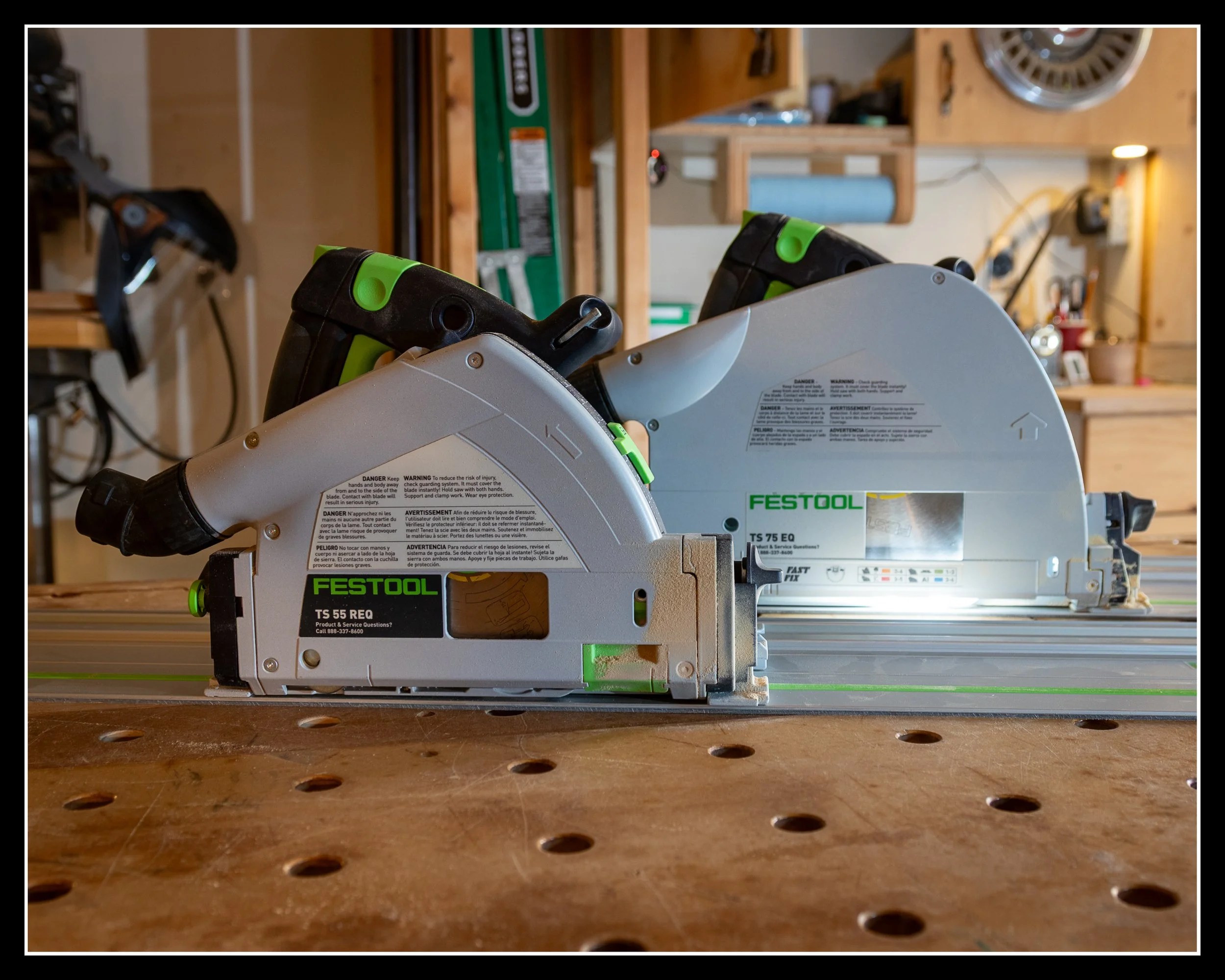
Festool TS 55 and TS 75 Track Saws on the MFT Bench
The Festool TS 55 and TS 75 track saws side‑by‑side on the MFT bench show the full range of capability in the track‑saw system. The TS 55 handles everyday precision cuts, sheet goods, and workflow speed, while the TS 75 brings deep‑cut power for thick stock and structural work. Set on guide rails across the MFT, this setup highlights accuracy, repeatability, and the versatility that makes track saws central to modern shop work.
Dealer Support
I use Festool track saws, but this isn’t a brand review. I don’t care which brand is “best.” I care about dealer support.
Track saw systems rely on rails, clamps, connectors, splinter guards, and replacement parts. Big‑box stores carry whatever sells this year. Specialty tools get replaced by cheaper brands overnight. That’s a headache when I’m in the middle of a job and need a part today, not next week.
Festool dealers stock accessories. That’s the biggest reason I buy Festool — long‑term support matters. Off‑brand systems come and go. You don’t want a tool that’s discontinued in a year or two, leaving you with no options for new track or replacement parts.
Dust Collection
Cutting MDF without dust collection fills the air in minutes. In a small shop, that’s dangerous. A HEPA extractor almost eliminates the problem. It keeps the air breathable, the shop cleaner, and the workday healthier. Dust control isn’t optional in a small space.
The Festool track saws are excellent at dust collection. The saw, the track, and the extractor work together to keep the cut clean and the air clear. When you’re cutting MDF, melamine, or plywood indoors, that matters more than people think.
Dust collection is one of the quiet advantages of a track‑saw system. In a small shop, it’s the difference between a clean workflow and a cloud of dust hanging in the air.
Clean Takeaway
Track saws aren’t perfect. They’re slower than big machines, they require a good bench, and they cost money. But in a small shop, they solve more problems than they create. Mine have paid for themselves many times over.
I’ve had onsite workers who are envious of my track saw, and I’ve had others who think I’m nuts for spending that kind of money on these tools. Those guys are always employees, not business owners. I don’t care what they think. These tools fill a hole in my shop, and they fill it well. They let me work with clean cuts and high accuracy, and I know exactly what my clients expect.
And if you’re a hobbyist thinking about a track saw and you’re unsure about the price, think about this: people with motorcycles, cottages, golf memberships, and fishing boats all have expensive hobbies. If your hobby is woodworking, the cost is a personal choice. Are you worth it? Only you can answer that.
They’re accurate.
They’re portable.
They’re small‑shop heroes.
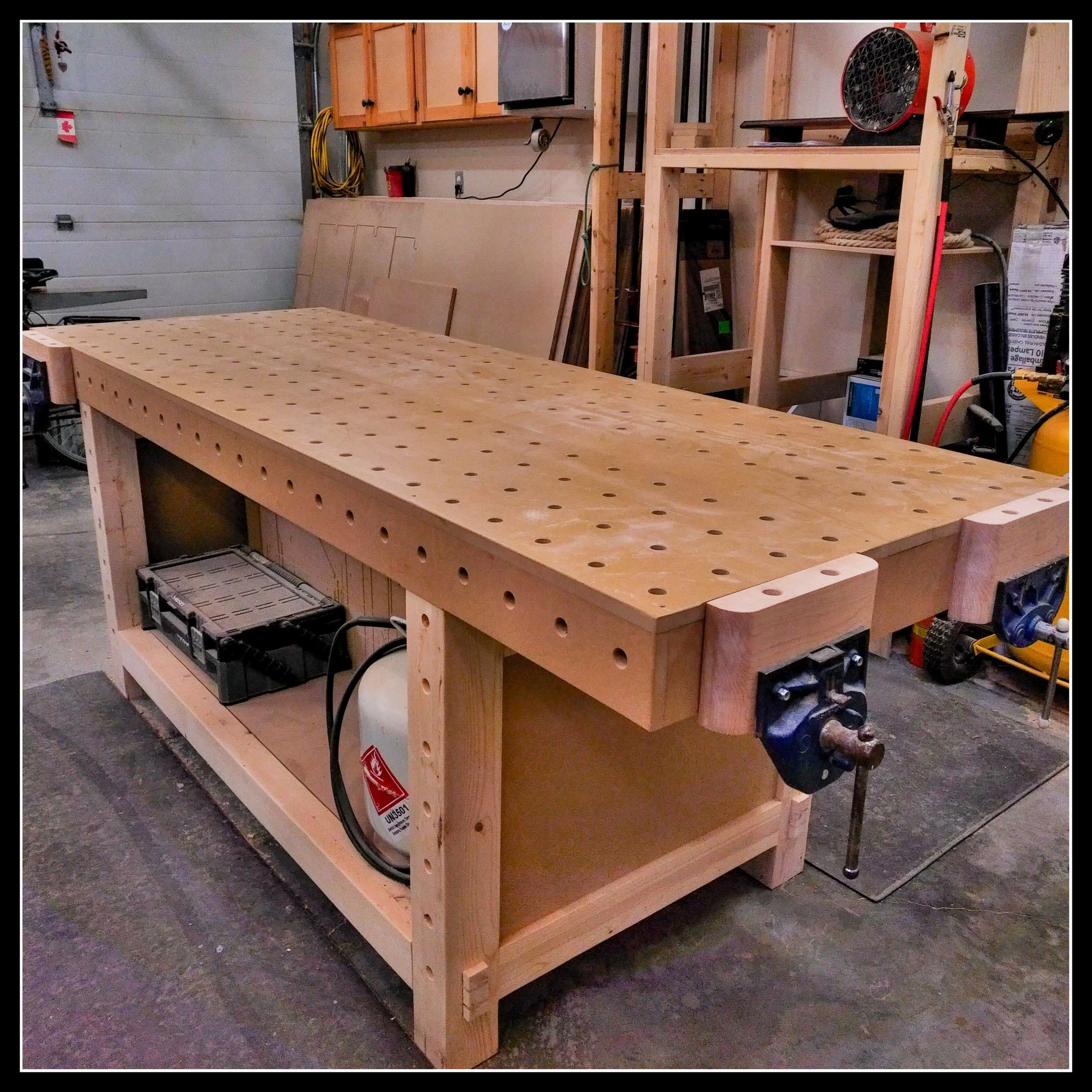
The MFT Bench — Dead‑Square Geometry on a Rock‑Solid Platform
This bench is built from MDF and spruce, engineered for mass and stability. The top is a full MFT grid, every 20 mm hole perfectly square to every other across the entire surface. That dead‑square geometry is what makes the bench a precision platform instead of just a work surface. The weight keeps vibration out of the workflow, the dogs lock the rail in place, and the whole setup becomes the foundation for accurate cutting, clamping, sanding, and layout in a small professional shop.
Together, gathered in one place so the machine stories, tool reflections, and workflow moments stay connected — easy to find and easy to return to.
SHARE
The Working Side of the Craft — Connected Through Machines, Tools & Stories
If you want the stories shaped by table saws, bandsaws, grinders, fences, and jigs — the honest, noisy side of woodworking — the Working Side Of The Craft is one click away.
If you’d like to hear from me only when something big is happening — a launch, a milestone, or a major project — you can join the mailing list below.
Written by David Flather, Red Seal cabinetmaker and founder of Knotty Dave’s Fine Woodworking — a Manitoba shop rooted in heritage restoration, storytelling, and real craft.
All photos shot by David Flather — in the shop, on the road, and in the places where craft and story meet.
Related stories:
My First Bandsaw That Didn’t Suck — A Woodworker’s Journey Through Vintage Saws
Contractor Saw vs Cabinet Saw: The Real Difference I Learned the Hard Way
The Radial Arm Saw: Forty‑One Years of Real Shop Use, Safety, and Cross‑Cut Accuracy
Orbital Sanders: Why They Leave Waves & How Pros Keep Surfaces Flat
The Workshop Library
If you enjoyed this story, there’s lots more like it inside The Workshop Library — and it’s free to explore.
Wood Archive — species, grain, working properties, and real‑world craft notes
Behind the Grain — the deeper stories inside wood, craft, and heritage
The Working Side of the Craft — tools, shop life, workflow, and the realities of making
Digital to Sawdust — Design Studio — geometry, proportion, visual flow, and design thinking
The Stories of the Shop — the personal side of craft, the shop’s history, and the quiet moments that shape the work
House & Hearth — heritage home restoration, the hearth room, winter culture, and the lived‑in side of craft
I’m just one man with a shop, building this archive one story at a time. If you’d like to follow the journey as it unfolds, explore The Workshop Library — new stories every week.
