

Ash
Quick Answer: What is ash and why is it threatened?
Ash is a family of North American trees — white ash, green ash, black ash, and several regional cousins — each with different habitats and uses. White ash is the woodworker’s hardwood, green ash is the prairie shelterbelt tree, and black ash is the cultural basket‑making tree. All are now threatened by emerald ash borer, an invasive beetle that kills ash by destroying the inner bark pathways the tree uses to move sugars.
Ash is a family of species
Green ash shaped prairie shelterbelts
White ash is the woodworker’s hardwood
Black ash is the basket‑making tree
Emerald ash borer kills all ash species
North America’s ash collapse is inevitable
Ash — A Family of Trees Across a Continent
Ash is a family of trees spread across a continent. Not siblings, but cousins — each living in different climates, shaped by different soils, with their own strengths and their own roles in the places they grow. White ash in the forests, green ash on the prairies, black ash in the bogs and waterways. Every one of them has value to the people and wildlife that depend on them. And as different as they all are, they share a single threat. Emerald ash borer is not native to North America, and it is decimating the ashes we know. This story looks at ash, and the beetle that’s threatening its existence.
BY THE END OF THIS STORY
You’ll understand how green ash shaped prairie shelterbelts, why white ash became the woodworker’s hardwood, how black ash shaped cultural craft in the east, and how emerald ash borer threatens every ash species across Manitoba.
Estimated read time: 12 minutes
Ash Species — Quick Comparison
Green Ash — prairie tree, shelterbelts, wind resistance
White Ash — hardwood, tools, bats, furniture
Black Ash — basket‑making, wetland tree
Emerald Ash Borer — invasive beetle, kills all ash
Habitat — prairies vs forests vs wetlands
Wood Properties — strong, springy, open‑grained
Fast Summary
Ash is a continent‑wide family of trees — green ash shaping prairie shelterbelts, white ash defining generations of tools and furniture, and black ash carrying deep cultural craft in wetland regions. Each species has its own habitat, strengths, and role, but all share a single threat: emerald ash borer. The beetle destroys the inner bark pathways that move sugars, making the collapse of North America’s ash inevitable. From prairie windrows to hardwood forests, ash is still standing today, but its decline has already begun — a quiet, continent‑wide loss that will reshape landscapes, craft, and memory for generations.
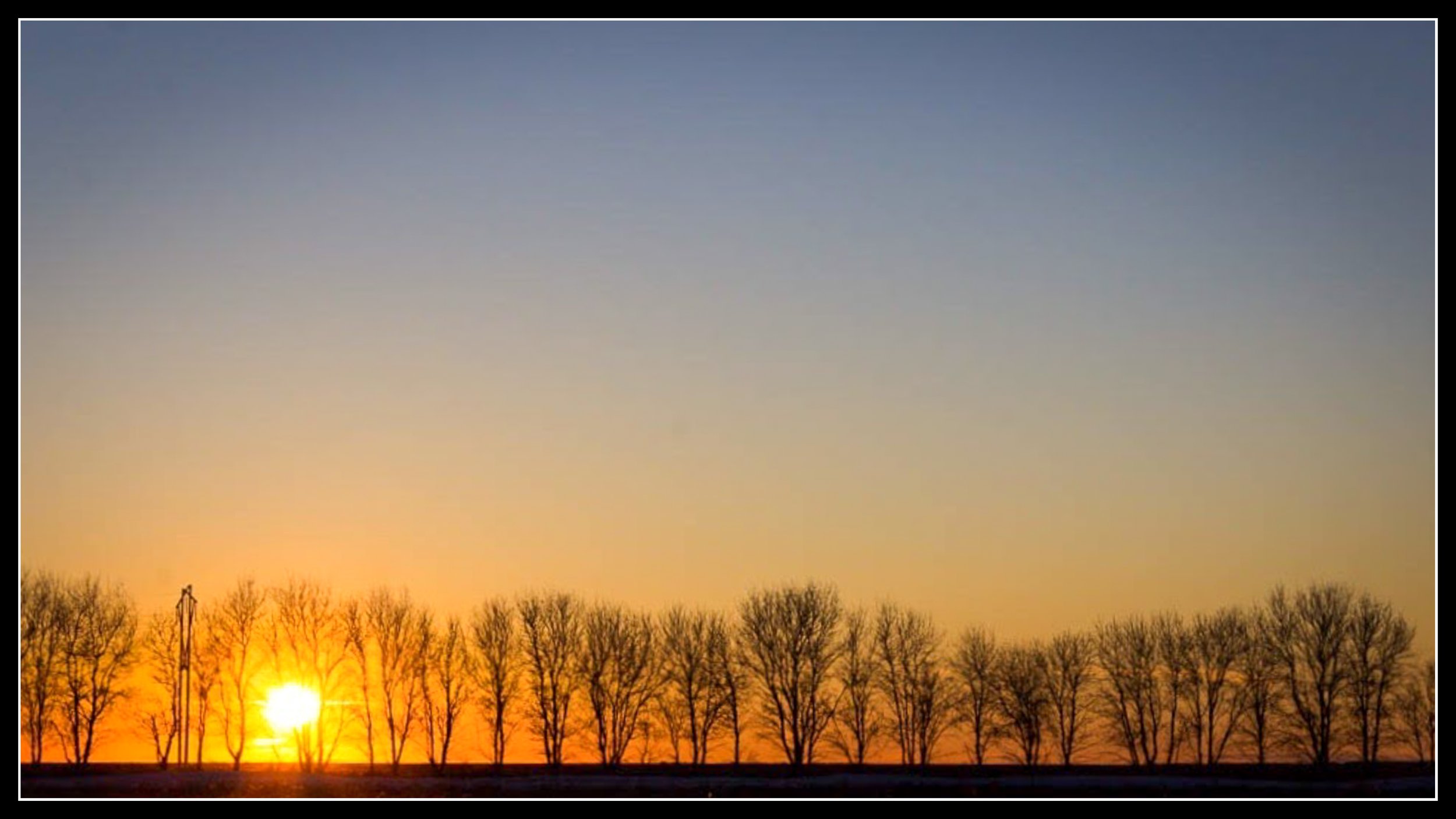
Windrow at Sunset, Red River Valley
This is one of the shelterbelts that define prairie life — a single row of trees standing against the open horizon, taken at sunset during the spring melt. In the Red River Valley, shelterbelts like this protect farmland from erosion, trap winter snow, and break the force of storms that roll in across flat land. Green ash anchored rows like these, shaping the landscape for generations. This photo shows the kind of shelterbelt the Ash story is built on — the quiet infrastructure of the prairies, now facing a future without the trees that held the wind back.
Prairie Wind and Shelterbelts
Ash lives across a continent, but to understand the ash I grew up with, we have to start on the prairies. In rural Manitoba it’s a lot of farmlands. Real flat farmland. There are no hills, no valleys, no distant mountains. In some places you can stand looking north to the horizon line with an unbroken view, turn around, and again see a clean sightline to the horizon. It’s so flat, it’s amazing. This is the Red River Valley — the flattest land in Canada. But that doesnt mean there’s nothing to see. The biggest feature is the sight of oncoming storms on a hot July afternoon: giant cumulus clouds rolling in from the west. Thunderheads with big white crowns and dark grey bases hang in the distant sky waiting for the right moment to come alive.
Prairie Storms and Extreme Weather
These storms are heavy, laden with rain, and they move fast. They come with wind, funnel clouds, and sometimes tornadoes. And on land like this, there is little shelter. The winds scour the fields, whipping dust and debris until the rain falls in a curtain that drenches and cools everything. But the storm always promises a good show of power and presence.
And when the storms pass, the land shifts into its other extreme — the deep cold of prairie winter.
In Manitoba each season comes with wind, precipitation, and temperature swings. In winter, the valley is cold. Rural schools cancel classes when the windchill is –45°C or colder, and it doesn’t take much wind for this to happen here. That’s a cold day for the kids — not to be confused with a snow day, which comes with heavy snow and wind. That reduces visibility and makes highways dangerous. Roads get closed. This is a prairie blizzard, and sometimes they last for days.
All this winter snow leads to spring floods. On flat land like this it’s a floodplain. The valley can turn into a temporary lake until the water drains. But with lakes, on windy days we get waves, and that can destroy dikes and infrastructure. So the point is: wind is ever present. It’s a major characteristic of prairie life, part of the land’s identity. Rural or urban, we all feel the wind year round.
And because the wind shapes everything here, people have shaped the land in return.
This is farm country, and the people who live here adapt to the temperatures and winds. We dress for the season, and in summer, to break the wind, we plant trees — lots of trees. We surround ourselves with them. In rural areas, homes are wrapped in shelterbelts. Hundreds of trees surround farms and equipment. The trees are thick and tall. They form an island in a sea of wind and storms, protecting us from the extremes that Manitoba and other prairie regions are known for.
A good shelterbelt has a row of low shrub trees like caragana or cotoneaster, a tall fast-growing tree like poplar or Manitoba maple (box elder), then a row of green ash followed by a row of spruce. That will almost stop the wind. A belt like this adds value to rural property through beauty and function.
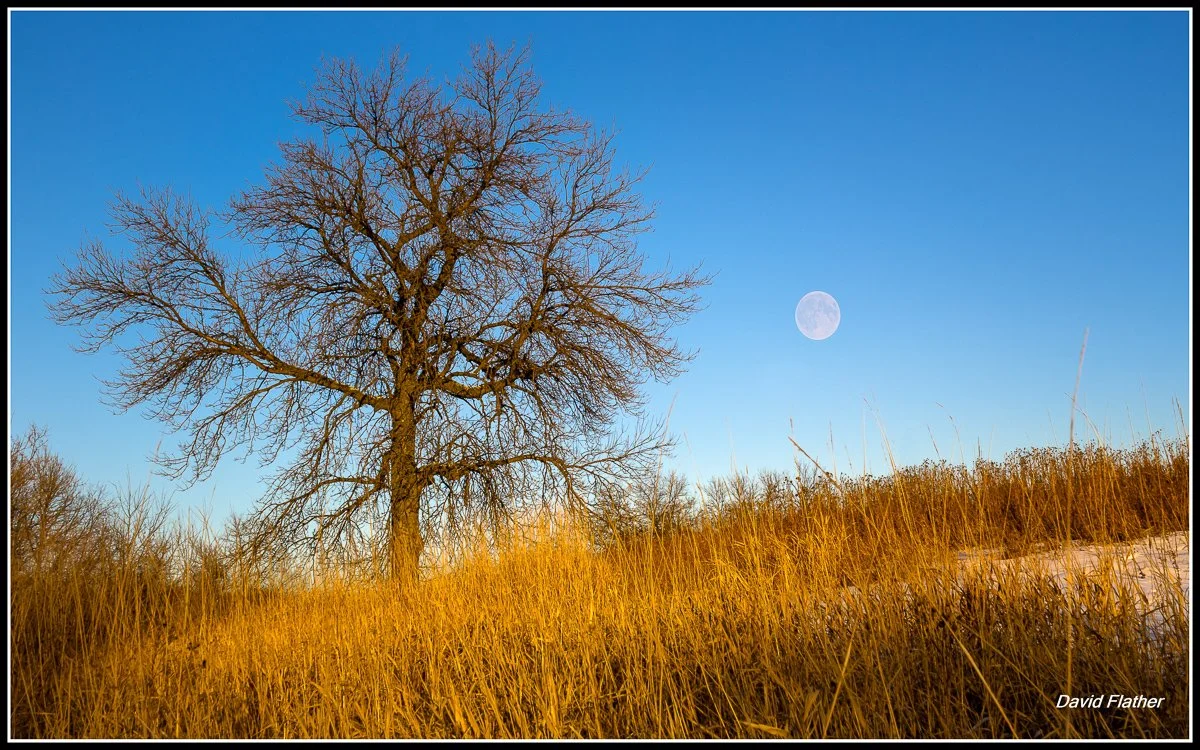
Green Ash on the Red River Bank, Winter
This green ash stands on the bank of the Red River in Winnipeg, photographed in winter when the land is bare and the structure of the tree is fully visible. Trees like this line the riverbanks across Manitoba, anchoring soil, breaking wind, and shaping the landscape in ways most people never notice. Green ash has been part of the prairie identity for generations — in shelterbelts, windrows, parks, and river corridors. This photo connects directly to the Ash story: a single tree holding its place on the riverbank, part of the millions now facing the emerald ash borer’s arrival in the province.
Green Ash — The Prairie Tree
Trees are also planted in rows that span farmland for miles. A single row of green ash is a common sight. It’s a tree that can handle the wind and floods well. It’s native to the prairie and does well in clay-based soil. It grows fast enough, resists the wind’s power for decades — maybe centuries. A shelterbelt prevents wind erosion and traps winter snow in drifts so the fields have spring water and the soil stays in place.
Cities and towns have them as boulevard trees and park trees. They’re in schoolyards and golf courses. They do the same job as in rural areas: they cut the wind and beautify the landscape. Green ash became the tree of choice here after we lost so many elms to Dutch elm disease. It was the replacement.
But to understand ash as wood — not just as a prairie tree — we have to step out of the shelterbelts and into the shop.
This story is about wood. I’m a cabinetmaker, and this is the ash tree I grew up with. I’ve planted them, cared for saplings, and watched them grow. These trees have value, but not as a tree that produces lumber — except as firewood. And it’s a good, clean-burning wood.
Early settlers did use green ash. It was tool handles, snowshoes, paddles, barn beams, and as long as the wood stayed relatively dry it was okay outside. It was used for wagon spokes, as ash is a good wood for turning — and that’s saying a lot if settlers chose ash as their turning wood. It did the job well enough for people in the region.
But the ash most woodworkers talk about — the ash that shaped tools, sports, and furniture — isn’t green ash at all.
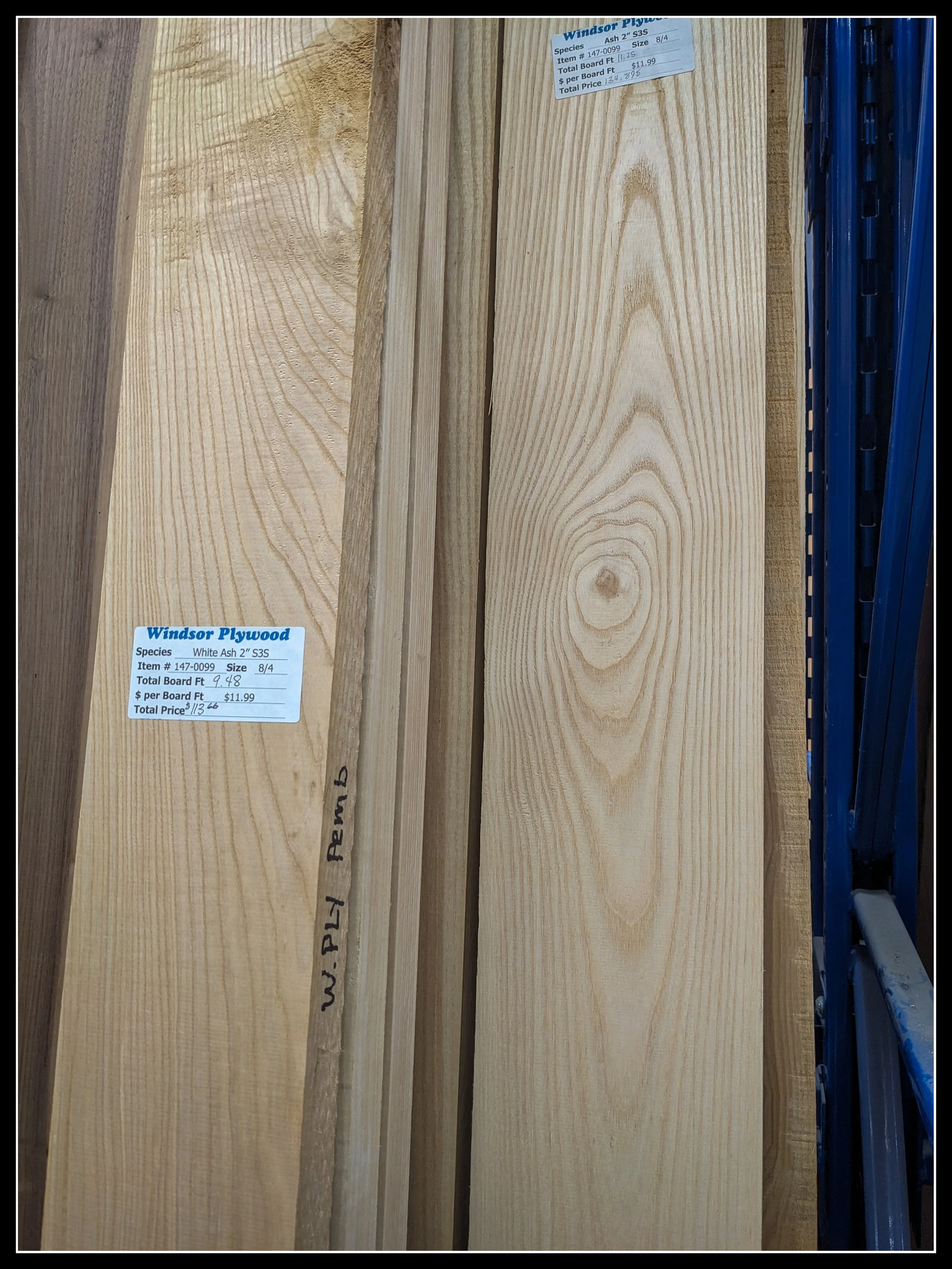
White Ash Lumber — The Woodworker’s Ash
These are white ash boards at a local lumber yard, photographed because I rarely have ash in the shop. White ash is the ash species used in woodworking — strong, stable, impact‑resistant, and excellent for steam bending. It’s the wood behind axe handles, baseball bats, paddles, and generations of furniture. In Manitoba, most shops work with oak, maple, walnut, and cherry, so white ash doesn’t appear often. This photo connects the story’s craft section to something tangible: the actual boards that represent the ash woodworkers talk about, in contrast to the green ash that shapes prairie shelterbelts.
White Ash — The Woodworker’s Ash
Green ash is not white ash. These two trees are not siblings; they’re more like cousins. White ash is a forest tree. It grows in competition with trees around it, so lower branches die off young and the tree top reaches for the canopy. This produces long, straight trunks that are mostly knot‑free. It’s a fussy tree that prefers rich, well‑drained soil, and it’s not good in floods. White ash is native to the eastern hardwood forests of North America, stretching from the Maritimes and southern Quebec through the Great Lakes and down the Appalachian region, growing in deep, nutrient‑rich soils formed by ancient glacial deposits and long‑weathered forest loam.
The wood is everything green ash wood is — just better. White ash is more stable, stronger, crack resistant, and has impact absorption, which is why it’s used for axe handles. Ash has a spring quality to it as well. For over a hundred years it’s been the wood of choice for baseball bats. White ash is an excellent steam-bending wood — among the best, really.
Here in Manitoba, when jobs come to the shop, they’re generally spec’d with white oak, red oak, maple, walnut, and sometimes cherry or pine. But I’ve never had an ash-built project except in college. That’s the only time it came up — and only because the college had us do everything woodworking in the name of education, and the ash was for steam bending. We built a real fancy desk for one of the classrooms we took theory in. But that’s it. No other jobs or projects. It’s not used much here; it could be a regional thing.
Honestly, I find the grain of ash to be loud compared to red oak, and red oak is already loud. In ash, the flashes of white and honey brown are prominent, but depending on the wood grade it could be tame if there’s lots of heartwood. The wood is open-grained and rugged looking. Rugged is fine — it has beauty like all woods. That ruggedness just needs to suit the design of what’s being built.
And ash has one more cousin — one that doesn’t live in forests or prairies at all.
Black Ash — The Basket Tree
There is also black ash, the most northern ash tree there is. Its range grows in an arc from Newfoundland to eastern Manitoba. It’s an eastern Canadian Shield tree. It grows where other hardwoods fail — swamps, bogs, and stagnant waterways. This tree doesn’t produce lumber, but it is the tree for basket making, a craft used by Anishinaabe, Mi’kmaq, and Haudenosaunee. I’ve never seen basket making, but I’d like to watch, learn, and give it a try.
Ash as a Family of Species
Ash is a family of trees. White ash is the tree valued for its wood. Green ash is the tree valued for its wind-breaking ability. Black ash is the tree of valued culture. They produce good firewood and shade on hot days. These trees were invaluable to all people of the land, of all ages. The history is so deep I can’t cover it all here. And still there are other ashes — blue ash, pumpkin ash, Carolina ash, Arizona ash, and Oregon ash. These ashes are all related, but at the same time all different from one another. Yet, they all have a common problem: the emerald ash borer.
And this is where the story turns — from the trees themselves to the threat that’s taking them.
Just a note: if you’re wondering about mountain ash, it’s not actually an ash. It’s a fruit tree. Just a misleading name.
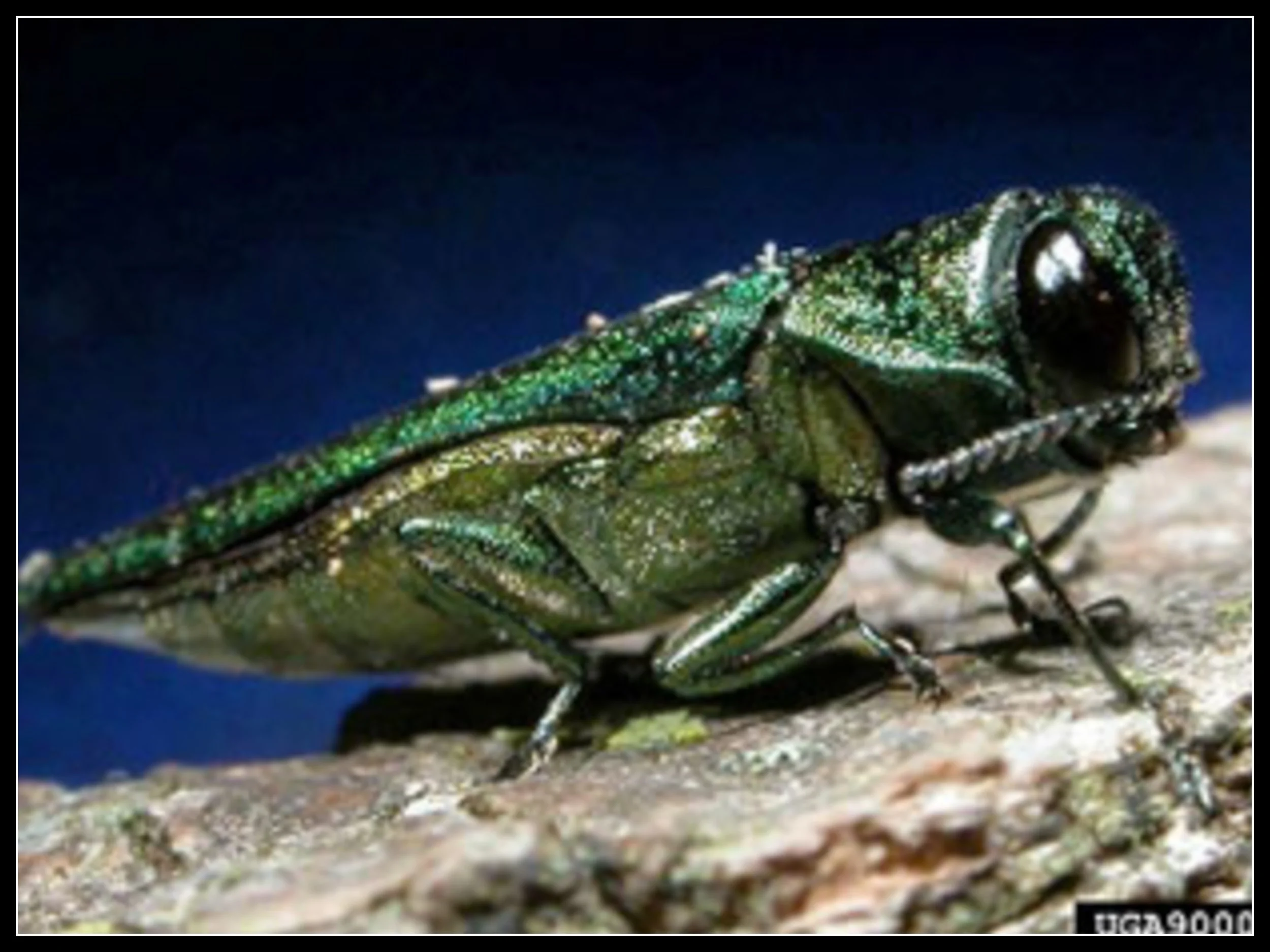
Emerald Ash Borer — The Invasive Beetle
This is the pest at the center of the story — the emerald ash borer, photographed in detail and shown here courtesy of the USGS. Its metallic green shell looks almost harmless, but this beetle is responsible for the collapse of ash trees across North America. The larvae feed in the inner bark, cutting off the tree’s ability to move sugars downward, and once that happens the tree starves. Every ash in Manitoba, from shelterbelt green ash to riverbank stands and black ash in the Shield, faces this threat.
Emerald Ash Borer — The Invasive Threat
My dad lives on a rural property just north of New Bothwell, Manitoba. On that land there are likely sixty green ash around his house. All the neighbours along his road have these trees too. And as I drive down the road for miles, every farmyard and house has them. There are long shelterbelts of these trees lined in fields to cut the wind — some I remember when the farmer planted them.
In 2017 the emerald ash borer (EAB) arrived in Winnipeg. I have yet to see any dead ash trees, and I’m sure most people haven’t either, but it’s here — and all these trees, there must be millions of them in the province, will succumb to this pest.
How Emerald Ash Borer Kills a Tree
The EAB is a beetle that lays its eggs on the surface of the tree’s bark. Once hatched, the larvae bore into the bark and feed on the inner layer. They live in the tree for two years, then emerge as beetles and fly off to other trees to lay eggs.
How does this kill a tree? To understand that, you need to understand how a tree lives. The tree is alive. There is wood, roots, bark, and leaves — that’s what most people know. Look closer: the roots collect water and minerals from the soil and clay. That moves up the tree through the sapwood (the living wood). This water and minerals move up to the leaves, where photosynthesis converts them into sugars. These sugars move back down through the inner bark. Between the inner bark and the sapwood is a layer called the cambium. This is the growth layer, where the tree builds the new growth ring for the year.
Correct order from the inside out:
Heartwood — dead xylem; storage and structure
Sapwood — living xylem; moves water and minerals upward
Cambium — growth layer; produces new xylem and phloem
Inner bark (phloem) — moves sugars downward
Outer bark — protection
The EAB feeds in the area of the inner bark and tunnels its way around the tree. This destroys the pathways the tree uses to move sugars downward. Once that happens, the tree starves to death. There is no cure or pesticide that solves this problem.
Ash in Manitoba — Collapse and What Comes Next
All those trees at my dad’s place, the neighbours’, the shelterbelts, the riverbank ash, the black ash in Whiteshell Provincial Park — even saplings with small 2.5 cm trunks — are not just at risk. They are doomed to suffer these aggressive pests. This has already happened out east, and in some areas ash is now extinct.
Back in the 1990s, all wood moving internationally had to be kiln dried so something like Dutch elm disease or EAB couldn’t cross borders. But the rules were for lumber. EAB didn’t arrive in lumber destined for market. It came in wood pallets and dunnage — wood that wasn’t regulated. It arrived in the Detroit–Windsor area from Asia. It was identified in trees in both Detroit and Windsor in 2002, but it’s estimated that EAB had been there since the mid 1990s. Ash in Asia have resistance to these pests due to thousands of years of coexistence and adaptation. North American ashes don’t.
The first cities that saw their ash trees die out were Detroit and Windsor. It took about fifteen years for complete collapse of the ash trees in those areas. And it’s been spreading ever since — from tree to tree, moving deadfall and storing firewood. Trees can be treated, but it’s temporary, needs repeating, and it’s expensive. It’s not a solution — just a way to save a few select trees. And now it’s in Manitoba.
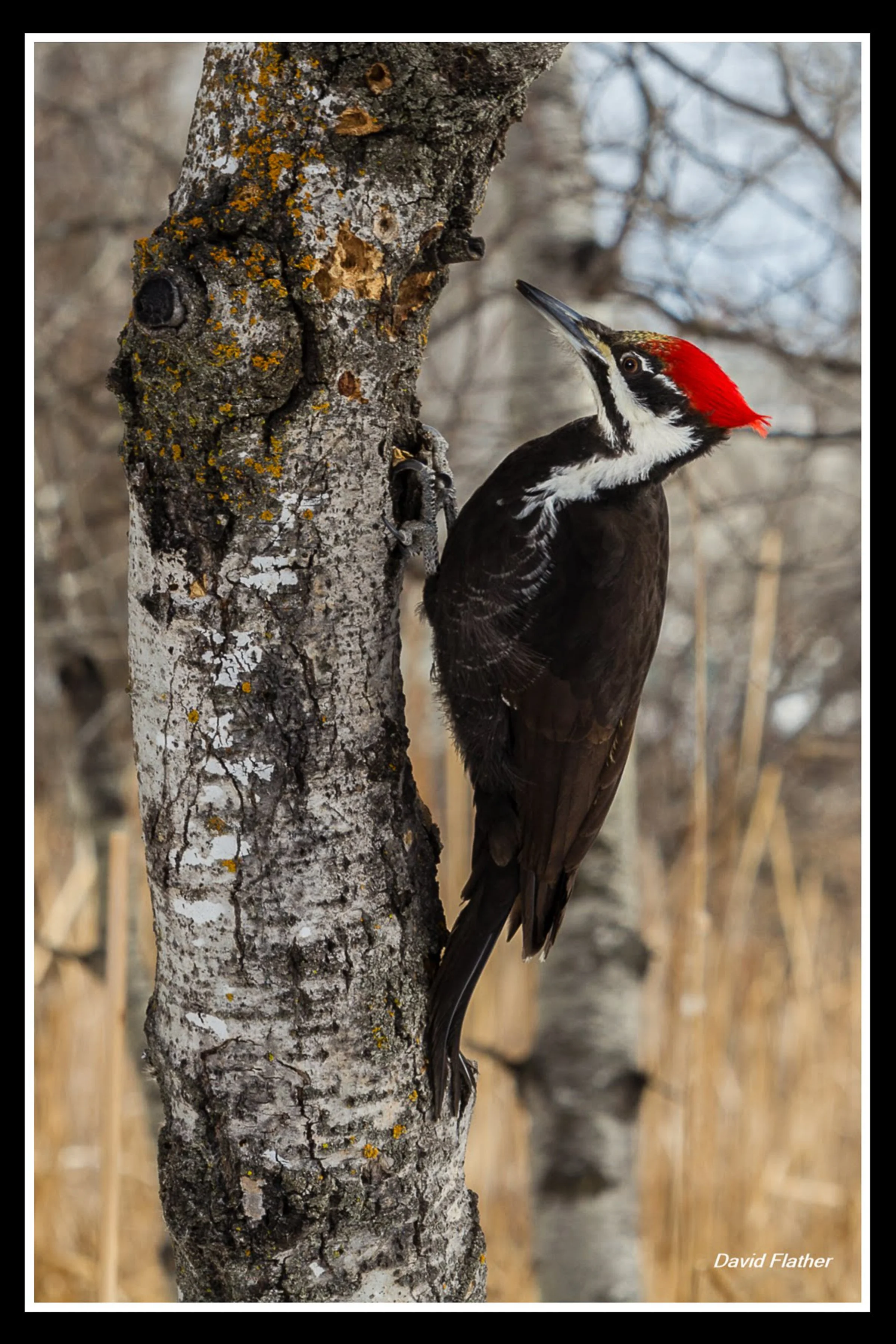
Pileated Woodpecker — Predator
Woodpeckers are the only real predator of the emerald ash borer, and in some areas they can reduce EAB populations by 30–60%. How much they help depends entirely on how many woodpeckers live in the region. In Manitoba, species like the downy, hairy, and pileated woodpecker hunt all year, chiseling into bark for EAB larvae and any other wood‑boring insects they can find. Shown here is the pileated woodpecker — the largest of them — doing exactly what it does best: searching the trunk for larvae hidden beneath the bark. This photo connects to the Ash story’s turning point, where the fate of the trees meets the role of the predators slowing the collapse.
Manitoba’s timeline will be slower — but the outcome is the same, It’s our cold winters. That’s a shorter summer season, that’s all. These eggs and larvae can survive temperatures down to –50°C with few casualties. The only predator they have here are woodpeckers, and they can cut populations down by 30% to 60% depending on conditions. But they can only slow the spread.
The only solution is letting the ash die out. When the ash are gone, the beetles will be too. The seeds of ash trees are being stored away so future generations can one day take these seeds and grow new ash trees.
Humans have used ash for thousands of years for survival and culture. But the world can be a harsh and unforgiving place. Much of what we know about ash is documented in books, videos, and stories. Future generations will not know this tree until one day it’s reintroduced to a safe North America. But for now, we must watch the fall of a mighty tree — an entire species across the continent collapse.
The land will feel different, bare, and the prairie wind will blow and gust. Blizzards will be fierce; summer storms will come alive. And there will be floods, and the ash will be gone.
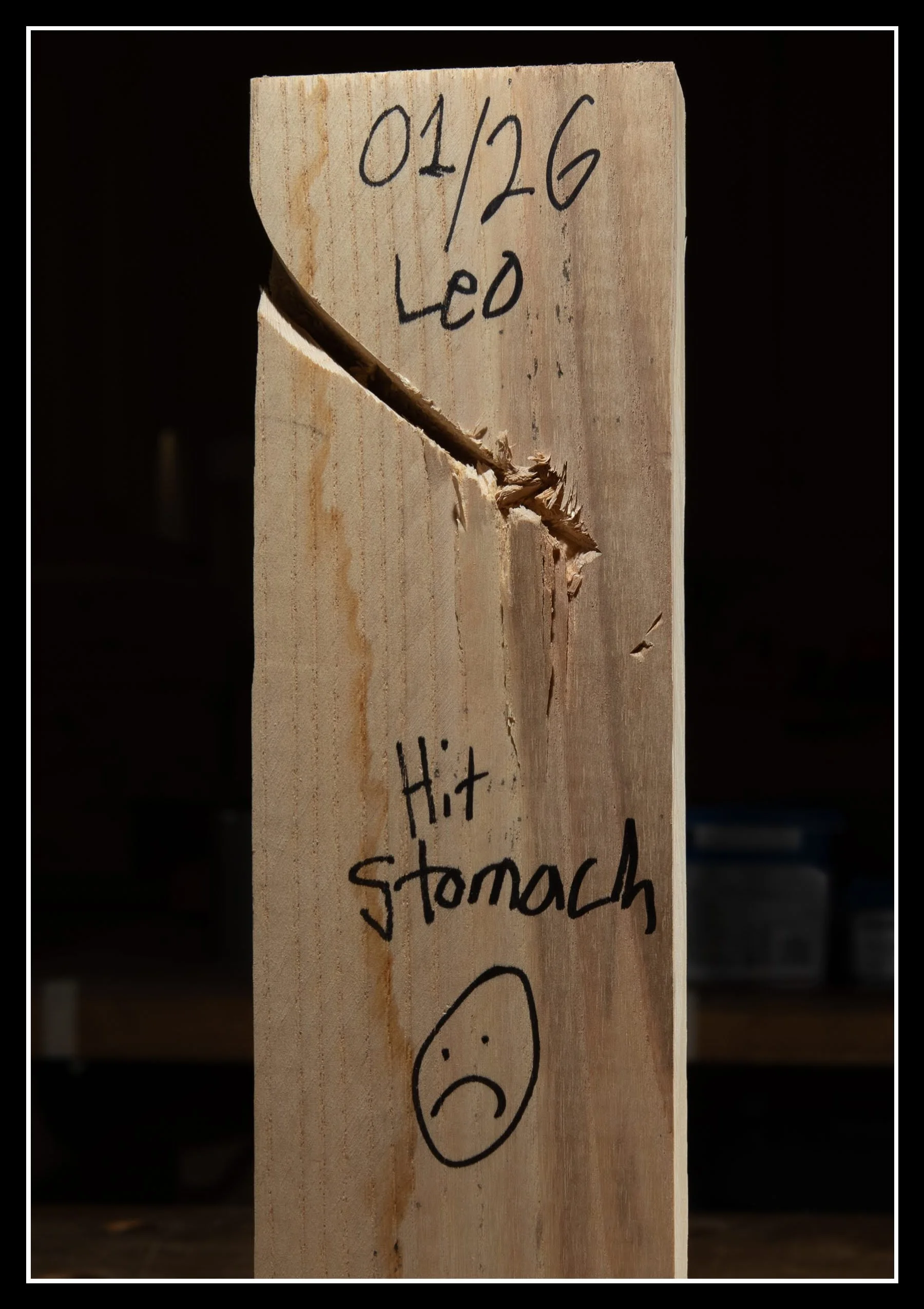
White Ash Kickback — Shop Impact
This white ash board carries the mark of a kickback — a deep impact that stops you the moment you see it. The date and quick note written on the surface turn it into a record of the moment, a reminder of how fast things can happen in a woodshop. White ash is strong, springy, and impact‑resistant, which makes the force of this kickback even more striking. This photocard ties the Ash story to the realities of working with hardwoods and serves as a preview for the Ramble called Kickback, where this board becomes part of a larger story about shop safety, experience, and the lessons wood teaches the people who work with it.
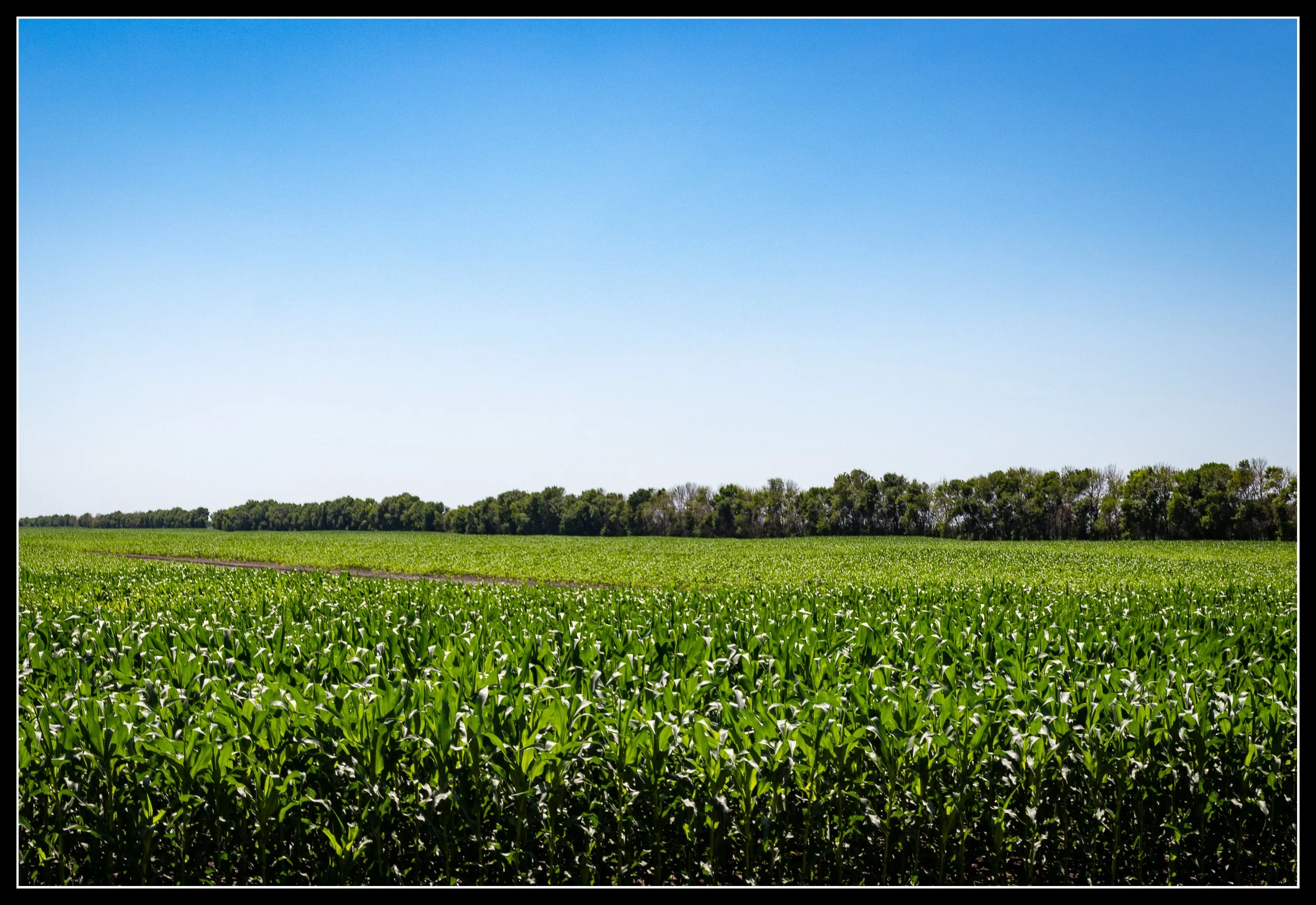
Green Ash shelterbelt Beside Cornfield
This row of green ash stands along the edge of a cornfield in the Red River Valley. I remember when these trees were planted back in the 80s — they were so small they disappeared under the height of the crops each summer. Over time they grew into a proper shelterbelt, doing exactly what prairie trees are meant to do: break the wind, trap snow, and hold the soil in place. Rows like this are part of the landscape’s memory, planted by farmers who understood the land and shaped it for the generations that followed. This photo, showing the kind of shelterbelt green ash create across Manitoba before the emerald ash borer arrives.
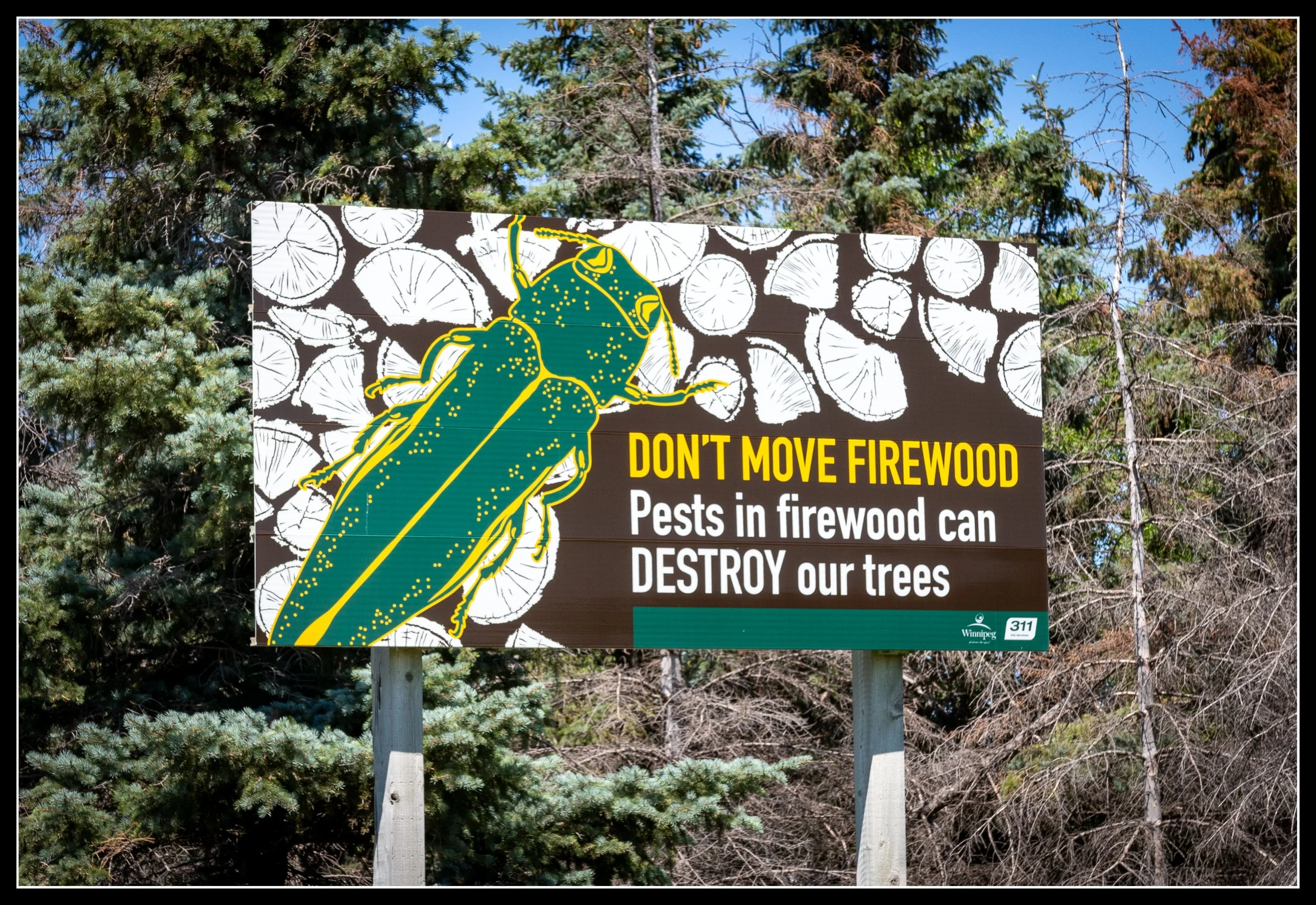
Firewood Quarantine Sign — Emerald Ash Borer Warning
This sign greets motorists as they enter town, warning them not to move firewood. The image of the emerald ash borer on the sign makes the message unmistakable: pests hidden in firewood can destroy entire tree populations. Winnipeg is a regulated zone, and signs like this mark the boundary where ash movement is restricted. For decades, green ash shaped the prairie landscape — shelterbelts, riverbanks, parks — and now the city is ringed with reminders that the species is under quarantine. This photo, showing how the threat is no longer just in the forest or the shop, but posted on the highway for everyone to see.
Manitoba’s Ash, Standing Strong in an Early Decline
Ash is still here, still working, still holding the prairie together in ways most people never notice. These photocards, this story are just a glimpse — a record of the trees as they stand today, before the story shifts, before the quiet early decline becomes something larger. If you want to understand ash in Manitoba, you start by looking closely now, while the crowns are still full and the shelterbelts still breathe.
Where every species, every board, and every lesson in wood science comes together — a place to explore the materials that shape our craft.
SHARE
The Wood Archive — All the wood Stories in One Place
For the living side of woodworking — the stories shaped by walnut, oak, maple, cherry, elm, cedar, and poplar — head to the Wood Archive.
If you’d like to hear from me only when something big is happening — a launch, a milestone, or a major project — you can join the mailing list below.
Written by David Flather, Red Seal cabinetmaker and founder of Knotty Dave’s Fine Woodworking — a Manitoba shop rooted in heritage restoration, storytelling, and real craft.
All photos shot by David Flather — in the shop, on the road, and in the places where craft and story meet.
Related Stories:
Cherry Wood: Grain, Colour, Tannin, and the Tree Behind the Boards
The Value of Wood in the Fur Trade: Winter Logging, River Transport, and York Boat Timber
Oak vs Oak: How White Oak and Red Oak Shaped Homes Across the Decades
The Workshop Library
If you enjoyed this story, there’s lots more like it inside The Workshop Library — and it’s free to explore.
Wood Archive — species, grain, working properties, and real‑world craft notes
Behind the Grain — the deeper stories inside wood, craft, and heritage
The Working Side of the Craft — tools, shop life, workflow, and the realities of making
Digital to Sawdust — Design Studio — geometry, proportion, visual flow, and design thinking
The Stories of the Shop — the personal side of craft, the shop’s history, and the quiet moments that shape the work
House & Hearth — heritage home restoration, the hearth room, winter culture, and the lived‑in side of craft
I’m just one man with a shop, building this archive one story at a time. If you’d like to follow the journey as it unfolds, explore The Workshop Library — new stories every week.
